

When you remember that you wanted steel-cut oats for breakfast, you get a certain kind of morning dread. The pot. The stirring all the time. When children are tugging at your sleeve, and your first meeting is already loading in another tab, you just don’t have forty-five minutes. The majority simply give up and aim for something quicker. However, it turns out that the answer was quietly cooking rice while seated on the counter.
Once you try it, using a rice cooker for steel-cut oats is almost embarrassingly easy. It’s not some obscure culinary trick. The steps involved in cooking rice and oats are remarkably similar: liquid, heat, absorption, and done. All of that is automated by a rice cooker, so you don’t need to be close by. One cup of steel-cut oats, roughly three cups of water, a lid, and a button are added. It takes care of everything, whether you have porridge, oatmeal, or even the typical white rice cycle. That has a subtle, satisfying quality.
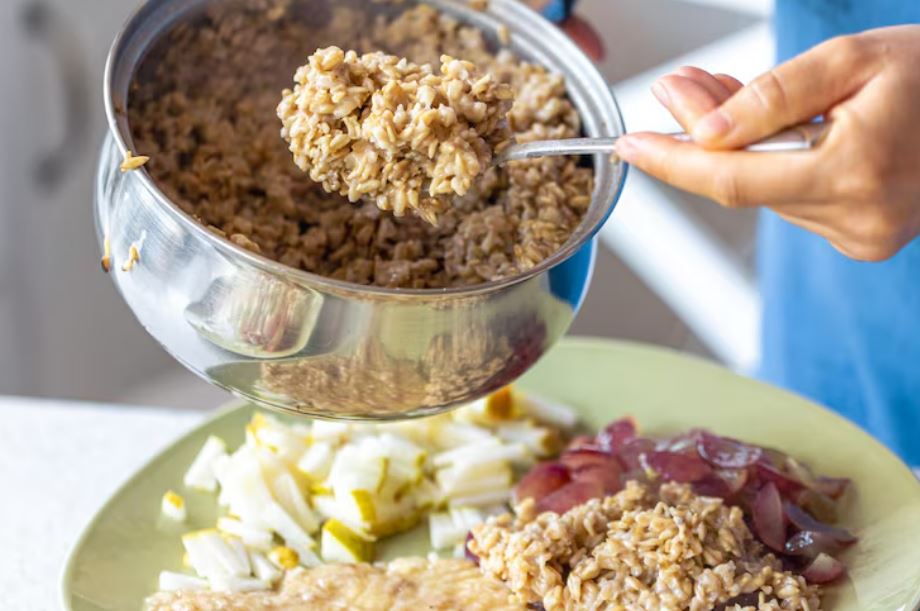
The timer feature, however, is the true magic. The night before, load everything into the pot. Water, oats, a dash of salt, and cinnamon, if desired. Just before your alarm goes off, set the timer to finish. This may sound too practical to be effective, but it is. Warm, thick, properly cooked oatmeal is there when you wake up, even though you did nothing at all while you were asleep. To be honest, it’s difficult not to feel a little arrogant about it.
It’s important to know that cinnamon acts strangely in water. It tends to clump and float rather than dissolve uniformly because it is fat-soluble. In order to ensure that the spice is evenly distributed throughout the cooking process, it is preferable to mix the cinnamon directly into the dry oats before adding any water. It’s the kind of detail that, until you taste the difference, seems insignificant.
More than anything else, the final texture is shaped by the ratio of oats to water. One cup of oats to three cups of water, or a 1:3 ratio, yields a thick, filling dish. In fact, if you’re making a larger batch to refrigerate and reheat over a few days, going up to 1:4 or even 1:5 results in something looser and more porridge-like. Cleaner reheating is achieved with thinner. Since rice cooker models differ significantly in how they distribute and retain heat, it’s worth trying once or twice to see what works best for you.
The reputation of steel-cut oats has always been a problem. Although they have more fiber, a lower glycemic index, and slower digestion than rolled oats, most people avoid them due to the time commitment. That barrier is successfully removed by the rice cooker. Although it doesn’t precisely speed up cooking, it eliminates the part that has always been the biggest challenge: the necessary attention. Additionally, the wait completely vanishes when the timer works overnight.
Most kitchens seem to have quietly underutilized the basic rice cooker. Once you start relying on it for breakfast, it quickly earns its counter space. On some mornings, a bowl of perfectly cooked steel-cut oats, prepared with no effort at all, is truly sufficient to make the entire day seem doable.
