
A child eating fruit is not the first thing you see in a Mexican schoolyard. It’s the cart’s absence. For years, vendors set up shop just beyond the gates, selling Dorilocos, chili-dusted peanuts, and frozen sugar in plastic cups. The after-school crowd would swarm them in the same manner that children everywhere swarm anything that adults haven’t had time to forbid. The government then made the decision to outlaw it last spring. Mexico quietly instructed its schools to empty the shelves with the message, “Farewell, junk food!” posted to X.
The ban, which went into effect at the end of March 2025, is more extensive than the headlines typically suggest. In Mexico’s approximately 255,000 schools, any product bearing even one of the black octagonal warning labels that the country introduced in 2020—the stark stop-sign stamps that scream high in sugar, high in fat—is now prohibited. Chips, soda, candies, flavored milk, and the little snacks made of soy and chili were consumed by generations. Theoretically, it’s gone. President Claudia Sheinbaum, who has vigorously advocated for the policy, stated it as simply as a head of state can: administrators who continue to sell them will be fined. She claimed that a bean taco is far superior to a bag of potato chips.
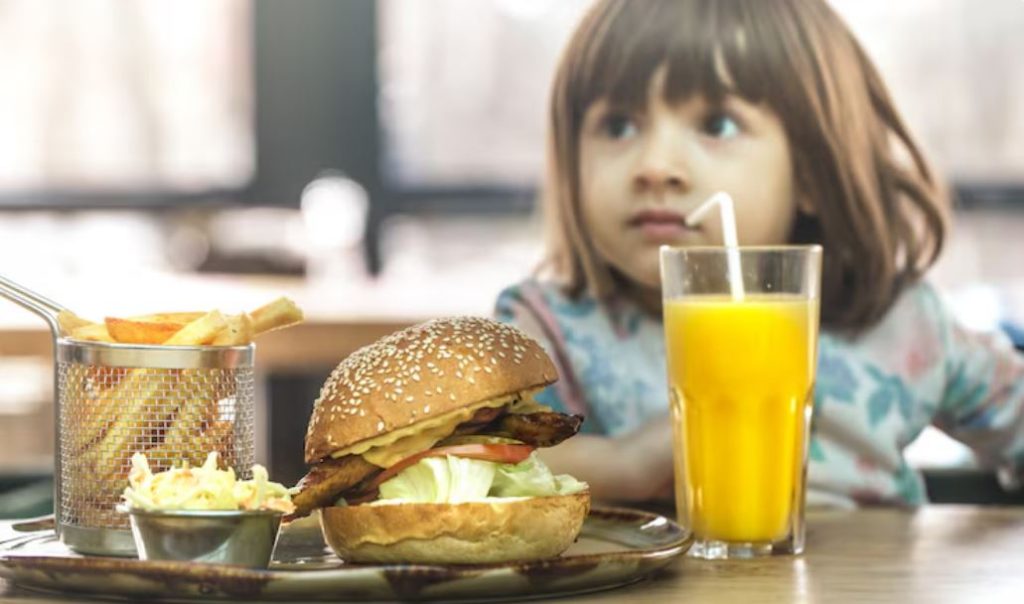
That line has an almost archaic quality. A president discussing bean tacos. However, the figures underlying it are anything but charming. The statistic that keeps coming up is the truly shocking one: about 40% of Mexican children’s daily caloric intake comes from ultra-processed foods and sugary drinks. UNICEF refers to Mexico’s childhood obesity as an emergency. Forty percent. That’s the true significance of the figure you may have seen circulating; it doesn’t mean that obesity has decreased significantly, as it hasn’t, but rather that this is the amount of a child’s diet that the nation was facing.
This is the point at which optimism needs to slow down. More than one-third of school-age children are still overweight, according to a government health survey published a few months after the ban. That’s not exactly failure. Economics, habit, and biology all proceed at their own speed. Decades of culinary culture cannot be undone in a single semester, and anyone hoping for a dramatic before-and-after was bound to be let down. Reading the coverage gives the impression that even officials are aware that this is a generational wager rather than a quick win.
What takes the place of the chips is the more difficult issue. The great majority of Mexican schools lack dependable drinking water, even though schools are supposed to provide water fountains and healthier snacks. It is assumed that hibiscus water is available when you advise a child to drink it instead of soda. Frequently, it just isn’t. It’s difficult to avoid wondering if the ban will succeed in the areas that most need it—the well-funded schools—and falter in the areas where it is most needed.
The world is still observing. Robert F. Kennedy Jr. has been raising similar concerns about ultra-processed food in Washington. The UK recently banned advertisements for junk food. Mexico went even farther, into the actual lunchroom. It will take years to determine whether it is profitable. The children must eat something, though, and the carts are gone. Maybe a bean taco for the time being.
FAQ’s
1. What did Mexico actually ban, and where?
The sale of any food or drink carrying a black warning label — chips, soda, candy, flavored milk — inside roughly 255,000 public and private schools, effective late March 2025.
2. Did childhood obesity really drop 40%?
No — that’s a misreading. The 40% figure refers to the share of children’s daily calories coming from junk food and sugary drinks, not any drop in obesity, which remains above one-third.
3. What happens to schools that break the rules?
Violators face fines ranging from about 545 to 5,450 pesos (roughly US $290).
4. Has the ban worked yet?
Too early to say — a government survey months in still found over a third of schoolchildren overweight, and officials expect results to take years.
5. What are kids supposed to eat instead?
Healthier options like bean tacos, fruit, and plain water — though many schools still lack reliable drinking water to make that switch real.
