

There is a sort of quiet cult following for Salata’s jalapeño avocado dressing. Frequent customers of the build-your-own salad chain will tell you, frequently without being asked, that the dressing—creamy, herbaceous, and just hot enough to surprise you—is what keeps them coming back. However, what precisely is contained within that green bottle? It turns out that the names of the fresh ingredients on the menu board may not accurately reflect the complexity of the nutrition label.
The dressing is in the middle of the pack with 100 calories per two-tablespoon serving. In and of itself, that is not concerning. However, the majority of people don’t measure two tablespoons precisely. The portion typically lands closer to four or six tablespoons, which raises the calorie count to 200 or 300 before the salad itself enters the picture, as anyone who has watched a salad bar employee ladle dressing onto a bowl will attest. The math is significantly altered by a minor detail.
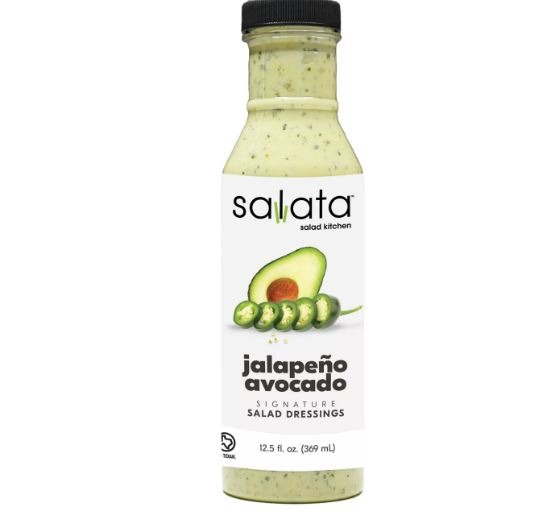
This dressing’s richness comes from its fat content. A base of mayonnaise, buttermilk, sour cream, and canola oil accounts for 10 grams of total fat per serving, or 13% of the daily recommended amount. The amount of saturated fat is 1.5 grams, which is quite low. The recommended daily intake of sodium is 270 mg, or roughly 12%. That is not unusual for a dressing. However, if you pour twice the recommended serving, you’ll be getting close to a quarter of your daily sodium intake from what most people still consider to be “just the dressing.”
Things get interesting—or, depending on your point of view, a little unsettling—when you see the ingredient list. It should come as no surprise that mayonnaise serves as the base, but the mayonnaise itself contains corn syrup, which is an odd detail in a product that otherwise leans toward bold, fresh flavors like cilantro, avocado, and jalapeño.
Mono- and diglycerides, carrageenan, and modified food starch are all present in the buttermilk component. Due to additives and ingredients that may come from genetically modified crops, the Environmental Working Group categorizes this product as an ultra-processed food.
The essence of the essential elements is what is truly appealing, and it is important to state this clearly. The list includes garlic, cilantro, lime juice, jalapeño pepper, and real avocado pulp. The product is not entirely synthetic. It contains real food. It’s more difficult to determine from a label alone whether those fresh ingredients are present in significant amounts or primarily function as flavoring, but their inclusion implies Salata wasn’t creating this solely using chemical shorthand.
Protein is at zero. Zero dietary fiber as well. Sugars are listed at less than one gram per serving, while carbs are listed at one gram. This dressing is essentially a fat delivery system with minimal contributions from anything else for someone who is seriously tracking macronutrients. Although it’s common for creamy dressings, naming without hedging is helpful.
At 45 milligrams, potassium makes up a small portion of the daily value, while calcium makes up about 1%. There are very few vitamins on the label. In terms of nutrition, you’re getting fat, a moderate sodium load, and the flavor that results from a well-made emulsion. That’s a fair exchange for a lot of people. One measured serving of this dressing combined with a salad full of veggies and lean protein is still a truly substantial meal.
The question is whether the majority of people are aware of the true appearance of one serving. The discrepancy between the labeling of dressings and their actual use is something to consider. Two tablespoons are listed as the reference on nutrition panels. The majority of people pour much more than that. It’s possible that the number of calories at the Salata counter appears to be lower than what is actually in the bowl.
Using a measuring spoon at least once is worthwhile if you’re using this dressing at home (it’s available through delivery services and grocery stores) just to see what two tablespoons actually look like. It’s not as big as most people think. It makes sense to add one serving to a large salad. When three servings are added carelessly, the computation is completely different.
The dressing is excellent in and of itself. Creamy avocado and sour cream balance the heat of the jalapeño, putting it somewhere between ranch and something truly unique. It’s difficult to ignore why it gained popularity. However, simple nutrition and delicious flavor don’t always go hand in hand, and this dressing is a clear illustration of that conflict.
FAQs
Q1: How many calories are in Salata’s Jalapeño Avocado Dressing?
One serving contains 100 calories, but most people pour two to three servings.
Q2: Is Salata’s Jalapeño Avocado Dressing considered healthy?
It’s real-ingredient-based but classified as ultra-processed by the Environmental Working Group.
Q3: What are the main ingredients in this dressing?
Mayonnaise, buttermilk, sour cream, avocado, jalapeño, cilantro, and lime juice.
Q4: How much sodium does one serving contain?
Each two-tablespoon serving delivers 270 milligrams — 12 percent of the daily recommended intake.
Q5: Does this dressing contain any protein or fiber?
Both protein and dietary fiber are listed at zero grams per serving.
