

Ten years ago, it was easy to spot the pattern in any gym: women gathered around the ellipticals and treadmills, logging hours upon hours of steady-state cardio, while the weight floor was still mostly occupied by men. Now, that image is clearly changing in ways that feel more like a reckoning than a trend. Women in their 40s and 50s are leaving the machines—not because they’re lazy, but because they’re frustrated. They had been relying on the cardio for years, but it had quietly stopped working.
This change might have been inevitable. For decades, there has been an embarrassingly lackluster body of research on the relationship between female hormones and exercise, with the majority of the foundational studies being done solely on men. A 2023 British Medical Journal editorial noted significant gaps in what we actually know about women’s cardiovascular health, musculoskeletal responses, and performance across different life stages. To put it another way, a lot of the advice given to women at the gym was based on data that had nothing to do with them.
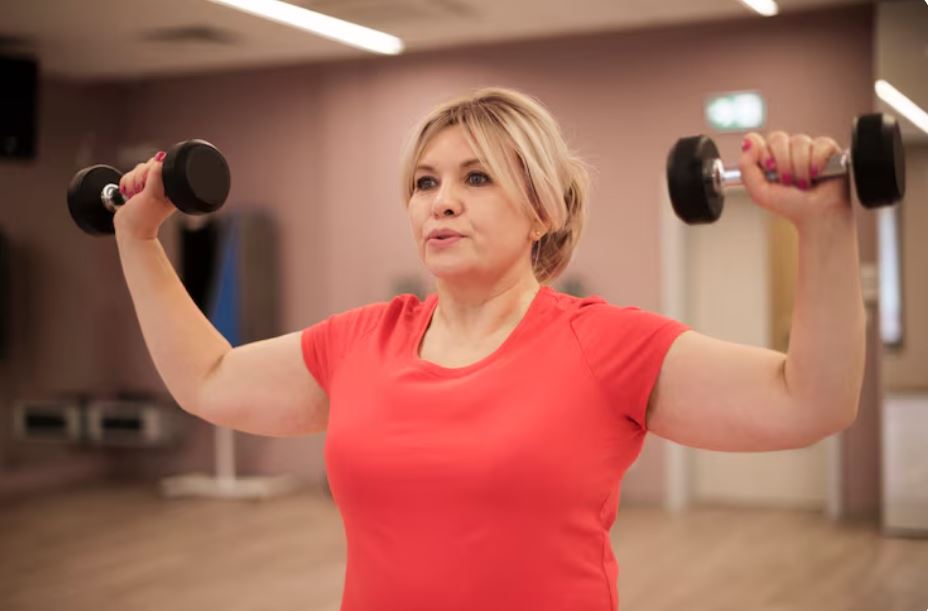
Dr. Stacy Sims, a sports scientist who has become somewhat of a lightning rod for this discussion, enters the picture. Her main points—that women are not small men and that women over 40 need to train fundamentally differently—have gained widespread acceptance outside of academic circles. Her ideas seem to stick, maybe because they align with what so many women have secretly suspected for years. She has appeared on almost every major podcast in the wellness space.
As estrogen declines during perimenopause, lean muscle mass drops faster, fat distribution shifts toward the abdomen, and the body’s stress response becomes more sensitive. It turns out that long-term cardio can exacerbate rather than reduce that stress response, increasing cortisol just when the body needs it most.
Before they come across the research, it seems like a lot of women are coming to this realization through experience. They had been sleeping worse, eating less, running more, and seeing the scale stay stationary. When someone explains why, both the frustration and the relief are genuine. Sims’s prescription isn’t to stop moving — it’s to move differently. Several times a week, she combines intense resistance training with what she refers to as polarized cardio, which consists of either easy, rejuvenating walking or actual high-intensity interval training. Nothing remains in the middle ground zone of moderate effort, which strains recuperation without providing sufficient stimulus to significantly increase cardiovascular capacity or build muscle.
This story also includes bone health, which is the aspect that usually hits the hardest. In contrast to steady cardio, resistance training puts mechanical strain on bones, which tells the body to maintain and increase density. That distinction is more important for women approaching the age at which their risk of osteoporosis increases than most people realize until they are made aware of it.
This change is intriguing because it feels so grassroots. Although they’re rapidly catching up, gyms and fitness brands aren’t the main drivers. It’s being driven by women comparing notes — in changing rooms, in group chats, in comment sections under Dr. Sims’s videos. The message appeals to women because it urges them to value their physiology rather than minimize it. Lifting heavy, building muscle, demanding more from the body rather than simply burning it down. That is a distinct fitness culture that is emerging at precisely the right moment.
