
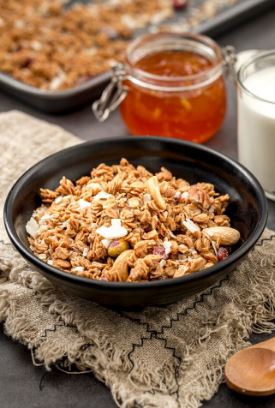
The Deliciously Ella Nutty Granola is hard to miss when browsing the free-from section of any reasonably stocked British supermarket. The branding conveys a calm confidence that many wellness food companies strive for but only a few truly attain, and the packaging is tidy and the font is not hurried. In most cases, the contents of the bag are actually better than what the packaging implies, though this isn’t always the case.
The granola’s recipe, which can be summed up in one sentence, consists of 60% gluten-free rolled oats, a revolving cast of cashews, flaked almonds, and crushed hazelnut pieces, date syrup and maple syrup instead of refined sugar for sweetening, and sunflower and pumpkin seeds for finishing touches. The ingredient list also includes orange juice, which quietly functions as a binder and adds a subtle citrus note that is more noticeable as warmth than flavor. It appears that the hazelnuts are crushed before baking rather than added whole. This is a minor detail, but it means that their flavor permeates the oats rather than existing in discrete pieces. It’s what distinguishes a granola that tastes thoughtful from one that just lists intriguing ingredients.
In 2012, Ella Mills started a blog called Deliciously Ella, which initially detailed a dietary change she made following a diagnosis of postural tachycardia syndrome. Over the years, what began as a personal story about eating differently evolved into one of the UK’s most popular food platforms, a cookbook series, a variety of packaged foods, and a London deli with her husband, Matt Mills. One of the brand’s best-selling products, granola, seems to contain some of that origin story. Rather than being created to fill a void in a market spreadsheet, it is clearly a product created by someone who genuinely considers what they eat.
However, the response hasn’t been totally straightforward. Despite the granola’s gluten-free certification, some users had digestive problems after eating it, according to a thread from last year on Reddit’s celiac community. The conversation was primarily quantitative, focusing on the high fiber content of a breakfast centered around seeds and nuts or on avenin, a protein found in oats that some celiac disease sufferers react to independently of gluten. It’s possible that this granola just packs too much into one bowl for some people with sensitive digestion. All of this does not make it a defective product in the broadest sense, but if you’re just starting to manage a digestive condition and you think that being gluten-free means it’s safe for everyone, it’s worth knowing.
For most people who eat it, it appears to be a straightforwardly good experience. It goes nicely with cold milk, whether it’s plant-based or not. It functions when layered with berries in a yogurt pot. Although it may not be the intended use case, eating it dry, handful by handful, appears to be so common that the brand practically acknowledges it and advises keeping the bag on your desk. The sweetness remains balanced—present without overpowering—and the crunch holds up fairly well. Most commercial granolas fall short in this regard.
Over the past ten years, the UK’s granola market has grown significantly, and the category is now genuinely crowded, with dozens of brands occupying similar space around natural ingredients, whole foods, and free-from certifications. Whether the Deliciously Ella brand maintains enough uniqueness to outperform more recent competitors who are fiercely competing on price is still up for debate. It is not inexpensive for a breakfast cereal at £3.95 for 380g at Tesco, but considering the quality of the ingredients and the lack of fillers that make less expensive options seem excessive, the price is reasonable. Regular buyers appear to understand exactly what they’re getting for their money. It is more difficult to cultivate that kind of loyalty than it appears.
