

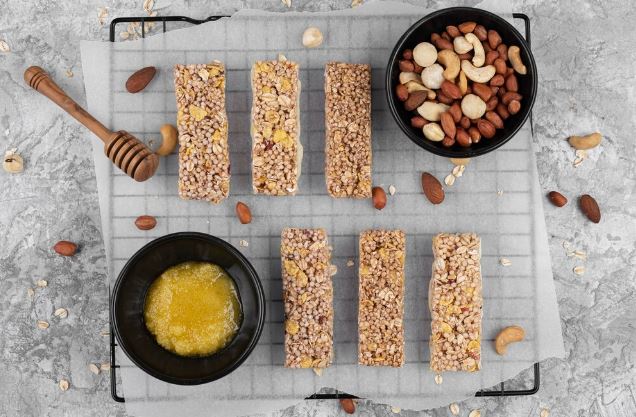
A recipe that won’t go away has a subtle stubbornness about it. For more than ten years, Yotam Ottolenghi’s granola bar has been making the rounds on food blogs. It has been photocopied, handwritten in notebooks, and transformed into health-conscious versions using chia seeds and coconut oil, but for some reason, the original still works. It’s easy to understand. That is, in part, the point. However, there is a difference between effortless, and this recipe occupies a very small but desirable area in between.
The dry mix is fairly simple: 190g of rolled oats, 30g of ground almonds, roughly chopped pecans, pumpkin seeds, sesame seeds, dried apricots, and sour cherries. The last two are added after being briefly soaked in hot water, which softens them just enough to prevent the final bar from going overboard. It is completed with a generous pinch of salt and cinnamon. Anyone who has spent time baking should not be surprised by anything found here. The caramel is what elevates everything. In a small saucepan over low heat, butter, Demerara sugar, and honey are coaxed until they deepen to a light amber, with a hint of toffee and almost floral honey scent. The transformation happens instantly when you pour it over the dry ingredients while it’s still hot, stir until everything is coated, and what initially appeared to be muesli turns into something worth firmly pressing into a tin.
Genuinely pressing matters. Home bakers who have made these more than once often mention it without being asked: pack the mixture firmly with the back of a spoon or an offset spatula—harder than seems necessary—and then place it in an oven set at 170°C for precisely 22 minutes. The bars appear surprisingly soft when they are finished. It’s important to resist the temptation to cut them too soon because they solidify as they cool. With the toasted pecans providing some resistance against the softer fruit, the final texture is chewy rather than crunchy. The pressing step might be what separates those who get neat bars from those who get delicious crumble.
The recipe has undergone enough modifications over time to warrant a small book of its own. Some bakers use cranberries instead of sour cherries. Some substitute maple syrup for honey, coconut oil for butter, and coconut sugar for Demerara. Chia and flaxseeds are added in one especially well-researched version, capitalizing on the superfood craze. The resilience of the core structure, however, is intriguing; the caramel-to-dry-ingredient ratio appears to be calibrated in a way that allows substitution without totally disintegrating. For home cooks, Ottolenghi has occasionally been a frustrating cookbook author; recipes from his books have received harsh criticism over the years due to inconsistent results and sometimes subpar seasoning. This one, though, holds. People reappear. It’s nothing at all.
It seems that the bar’s ability to blend in with its surroundings has contributed to its long-lasting appeal. Not quite a health food, not quite a treat, not quite a flapjack, and not quite a muesli bar. When consumed right out of the refrigerator, as some people like, the edges become nearly candy-like. In a warm kitchen at room temperature, it becomes stickier, softer, and more difficult to eat neatly. It usually goes away more quickly than anticipated in either case. The recipe makes enough for a 9 x 9-inch tin, which can be cut into individual bars and stored in an airtight container. However, most people don’t think they will last for a week.
