

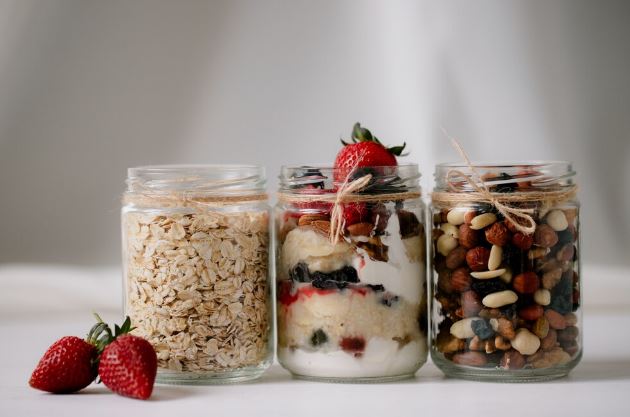
When you open the refrigerator on a Monday morning and see a row of well-assembled jars that have already been sorted, layered, and completed, you feel a certain kind of satisfaction. Granola and yogurt pots provide just that—not in the sense of an aspirational lifestyle, but rather in the subtle, pragmatic sense of a choice made the night before that pays off when your mind isn’t completely focused. It’s not the kind of breakfast that’s photographed in golden hour light with a linen napkin next to it; rather, it’s designed for actual mornings.
Thick yoghurt at the bottom, a spoonful of toasted granola in the center or on top, and fruit—fresh, frozen, and cooked down, or somewhere in between—that adds color and a hint of tartness to balance out the richness make up the disarmingly straightforward basic architecture. The layering, the intentional assembly of textures that remain distinct from one another if you’re careful about the order, is what sets the whole thing apart from a bowl of cereal poured in a hurry. The granola, which is important, is added after the yoghurt and compote, and it remains separate until you eat. You end up with something soft and slightly porridge-like if you let it sit in moisture for the entire night. Some people love this, while others think it completely defeats the purpose.
It’s easy to understand why Greek yoghurt has become the almost universal choice for a base. It’s thicker than regular yogurt, tangier, and high enough in protein to make breakfast more than just enjoyable. Skyr operates similarly. For those who don’t eat dairy, coconut yoghurt offers a distinct flavor that goes well with mango or passion fruit instead of the traditional berry compote. It’s sweeter, slightly looser, and has a subtle tropical undertone. Though a thick Greek full-fat yoghurt still has a creaminess that’s hard to duplicate, the plant-based versions may have improved enough recently that the distinction doesn’t matter as much as it once did.
The granola is where things get interesting, but store-bought varieties usually fall short. The majority of commercial granolas rely heavily on sugar to bind clusters and produce that delightful crunch. Still, by the second or third bite, the sweetness can turn into something cloying. You have much more control over all of this with homemade granola, which is made with oats, seeds, a little melted butter, and honey and baked for 20 minutes until the edges darken. Sunflower seeds, flax, chia, and pumpkin seeds all contribute texture and nutritional value without making the meal feel more like a supplement than a breakfast. Most people don’t think to add the unexpectedly delicious chewiness of toasted desiccated coconut to the oats.
Perhaps the most adaptable part of the pot is the fruit component. In the summer, a handful of fresh strawberries is ideal. In colder months, a bag of frozen mixed berries simmered for ten minutes with a little honey collapses into a thick, ruby-coloured compote that is genuinely better than most fresh fruit options — concentrated, slightly jammy, with the kind of depth that fresh berries at room temperature rarely achieve. Raspberries, blueberries, and cherries are all effective. Making a larger batch than you’ll need for a single morning is worthwhile because the compote keeps well in the refrigerator for several days.
It’s difficult to ignore how well this specific breakfast concept has held up over time. While the supermarket version, which is sold in tiny plastic pots at a significant markup, has become a common grab-and-go option in cafés and service stations, making it at home is significantly less expensive and tastes better. The jars last for several days. They go on trips. They serve both adults eating at a desk an hour into the workday and children who need something quick before school. For something put together in less than 30 minutes on a Sunday afternoon, that is a pretty broad brief.
