

Around 5:30 on a Tuesday night, a certain type of panic strikes. You’ve made a mental commitment to prepare chicken—perhaps a roast or something pan-fried—but you discover you forgot when you open the freezer. Once more. It is sturdy. It’s frozen. Dinner will be served in an hour. The instinct to either leave it on the counter or run it under hot water is nearly universal, so this is where things get really dangerous for many home cooks. And nearly always incorrect.
For many years, the U.S. Department of Agriculture has been largely consistent in this regard. They believe there are only three safe ways to thaw chicken: in the microwave, in cold water, and in the refrigerator. That’s all. There is a good reason why everything else—the countertop, the hot water bath, and leaving it in a warm oven—falls outside of those parameters. Salmonella in particular doesn’t wait for you to finish cooking. Even though the center is still a block of ice, it begins to multiply as soon as the chicken’s outer layer rises above 40°F. Foodborne illness thrives in the space between the outside warming and the inside remaining frozen.
It makes sense that food safety experts always advise using the refrigerator method first. This process keeps everything below 40°F, prevents bacteria from growing, and offers flexibility that no other method can match—chicken thawed this way can be refrozen if your plans change. Time is a major trade-off. Parts of chickens require a full day. It can take one to two days to finish a bird. It necessitates the kind of meal preparation that many people just don’t do on weeknights. However, this is actually the least hazardous choice for anyone with the foresight to take something out of the freezer the night before.
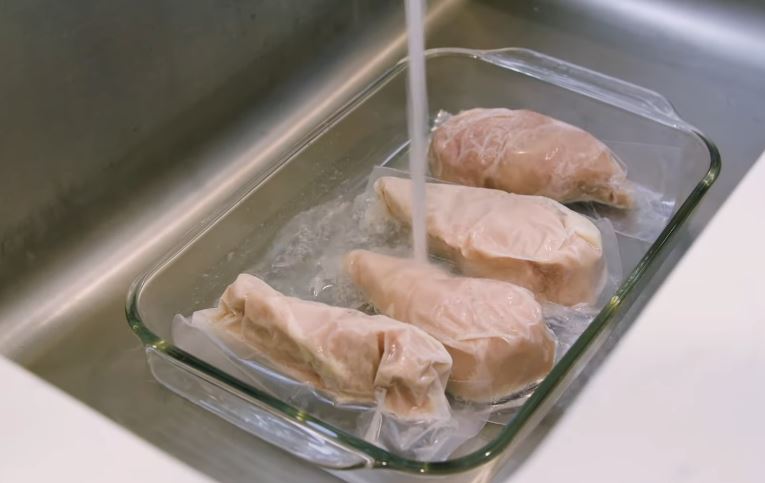
When the refrigerator method is no longer feasible, most people turn to cold water thawing. When done properly, it functions. It’s not much better than leaving items on the counter if done carelessly. The chicken must be kept in a sealed, leak-proof bag because bacteria from the surrounding water can contaminate the meat if there is a breach in the packaging. It is necessary to change the water every half an hour in order to keep it cold, rather than simply filling the sink and leaving it. It takes less than an hour for small cuts to thaw. Two to three hours of real, steady attention are needed to complete a bird. Additionally, it must be immediately placed on the heat as soon as it thaws; there is no holding time or time to leave it on the counter while you prepare vegetables.
There’s a reason why the microwave method is often considered a last resort. Uneven heating occurs in microwaves. Smaller portions and thinner edges of the chicken may actually start to cook while the center is still frozen, bringing those parts into the danger zone. This does not mean that you should completely avoid it, but it does mean that you must cook the chicken right away. In a hurry, it works perfectly for boneless thighs and breasts. It becomes more difficult, and the outcomes are less predictable when dealing with an entire bird.
Can you cook frozen chicken without thawing it at all? This is another important question that people seem almost ashamed to ask. In some circumstances, the answer is yes. As long as you factor in the longer cook time—usually about 50% more than you’d use for thawed meat—baking, grilling, and stovetop cooking can all handle frozen chicken fairly well. The thermometer is a crucial warning. An internal temperature reading of 165°F at the thickest part of frozen chicken is the only trustworthy indicator that it is cooked through. Slow cookers and other similar methods don’t work here because the meat doesn’t reach the proper temperature quickly enough.
Despite being aware of the risks, it’s difficult to ignore how many people continue to use the counter as a default. It carries some unspoken safety because it is culturally familiar and seems to have worked for earlier generations. However, statistics on Salmonella don’t really account for sentimentality. Approximately 4% of chicken packages in American supermarkets test positive for the bacteria, meaning that one out of every 25 packages at the grocery store has it on any given week. While it’s not exactly cause for concern, it should be taken into consideration when choosing where and how to thaw.
In all honesty, none of these techniques are particularly challenging. The refrigerator method requires preparation. The cold water method requires focus. The microwave method requires persistence. Even a hurried Tuesday night can accomplish all three. The chicken on the counter, slowly warming up to a temperature where dinner becomes more than just dinner, is the only option that truly poses a risk.
FAQs
Q1: What are the only safe methods for defrosting chicken?
The USDA approves just three: refrigerator, cold water, and microwave thawing.
Q2: Can you leave frozen chicken on the counter to thaw?
No — bacteria multiply rapidly once the outer layer exceeds 40°F.
Q3: How long does refrigerator thawing take for chicken parts?
Chicken parts need a full 24 hours in the refrigerator.
Q4: Is it safe to cook chicken straight from frozen?
Yes, but expect up to 50% longer cook time than usual.
Q5: Which thawing method allows you to refreeze the chicken afterward?
Only refrigerator-thawed chicken can safely be returned to the freezer.
