

A bowl of yogurt and granola has an almost embarrassingly straightforward quality. It takes about five minutes and two ingredients, but it looks like something you’d get for breakfast at a café that charges fourteen dollars, and you feel good about it. When you stroll through any grocery store on a Sunday morning, you can see people loading up on both the kraft-paper granola bags and the thick, strained Greek tubs, as if they’ve secretly discovered something that the rest of breakfast hasn’t yet figured out.
It’s really hard to dispute the numbers. A bowl consisting of two tablespoons of almond butter, a handful of mixed berries, and vanilla Greek yogurt provides about 21 grams of protein and 7 grams of fiber. It’s not a supplement. It’s not a protein shake with an unpronounceable ingredient list. Granola and yogurt in a bowl. There’s a feeling that people spent years overcomplicating breakfast—the intricate smoothies, the avocado toasts that call for three different knives—while this was patient and uncomplicated all along.
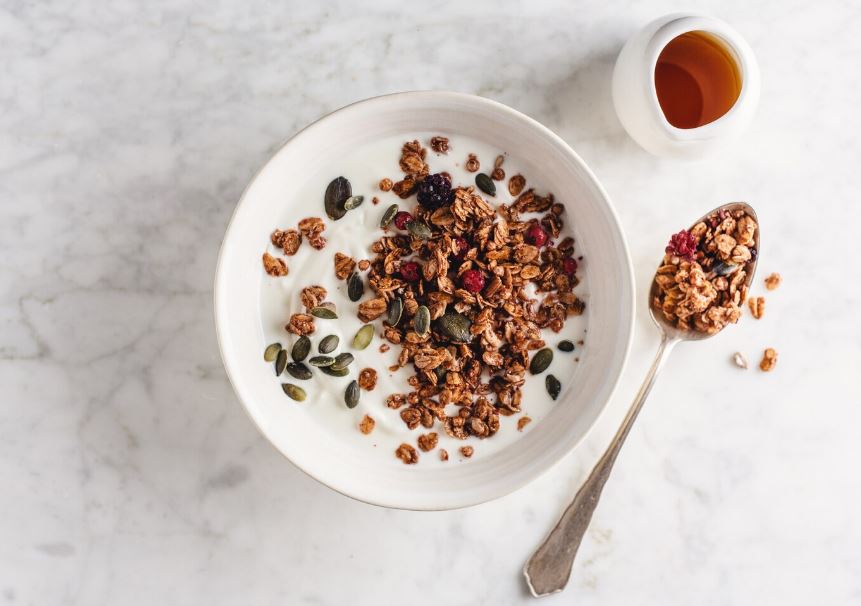
The flexibility is what makes it intriguing, at least to anyone observing how people eat these days. The base remains the same: granola, yogurt, and a sweet topping. However, it branches out in nearly every direction after that. Toasted coconut chips and cubed pineapple are a tropical option. With banana slices, granola butter, and a scattering of chocolate chips—which you should measure but hardly anyone does—you can go deep and decadent. Even in July, a version with crisp Honeycrisp apple and peanut butter tastes like fall in a bowl. Jamie N, a registered dietitian, easily enumerates ten variations, but it seems like the list could be expanded.
In this case, Greek yogurt in particular does a lot of the heavy lifting. The majority of the whey is removed during the straining process, leaving behind something thicker, tangier, and noticeably more filling than ordinary yogurt. This could be the reason why this specific combination keeps people full until lunch—a claim you hear all the time, and one that the fiber and protein content actually supports rather than merely suggests. Christine McMichael, a food blogger, has been preparing these bowls every day for years. She observes that her children treat them like a treat, and she is quietly pleased that they are consuming something that has real nutritional value.
Granola selection is more important than it might seem. Many commercial options have more added sugar than cookies and are more akin to dessert than breakfast. The better course of action is to look for fiber, a small amount of protein, and a reasonable amount of sugar on the label. Alternatively, you can make your own, which sounds ambitious but is actually quite simple once you’ve done it twice. Food writer Razena Schroeder, who popularized a grain-free version, observes that homemade granola has a tendency to become a snacking issue completely apart from breakfast, which, depending on your point of view, is either a warning or a compliment.
It’s difficult to ignore the fact that this bowl has outlasted a dozen more noisy breakfast trends. Bulletproof coffee, intricate overnight oat constructions, and acai bowls all had their moment. Granola and yogurt simply kept appearing in kitchens that weren’t attempting to accomplish anything, silently, every morning. Perhaps that’s the true reason it works. It provides more than you would anticipate and doesn’t ask for much from you.
FAQs
1. How long does it take to make a yogurt with a granola bowl?
It takes just 5 minutes to assemble from start to finish.
2. How much protein does a yogurt and granola bowl contain?
A single serving delivers around 21 grams of protein.
3. What type of yogurt works best for granola bowls?
Thick, strained Greek yogurt offers the highest protein and best texture.
4. Can yogurt granola bowls be made dairy-free?
Yes, coconut or almond milk yogurt substitutes work perfectly well.
5. What are the best toppings to add to a yogurt granola bowl?
Berries, nut butter, banana, honey, and toasted coconut are excellent choices.
