

It’s difficult to explain the silence that descends upon a factory floor once the final machine has stopped unless you’ve been there. On September 3, 2026, after 88 continuous years of production, the last box of Kellogg’s cereal came off the line at Trafford Park in Greater Manchester, bringing with it that silence. Knowing that it wouldn’t be the same type of walk-in tomorrow, 360 people, many from families who had contributed to this site for several generations, left.
Although the actual building will stay open until the end of the year while the winding-down process is finished, production at the Trafford Park location of the Kellogg’s Manchester factory officially ended on September 3, 2026. When you take into account the enormity of what this place used to be, the announcement has a different impact.
At its height, the 27-acre site—once regarded as one of the biggest food manufacturing facilities in Europe—produced up to one million boxes of cereal every day, including Corn Flakes, Rice Krispies, and Coco Pops. A million boxes. Every day. Until you imagine the trucks waiting outside, the moving conveyor belts, and the scent of toasted grain wafting through the industrial estate, that number hardly seems real.
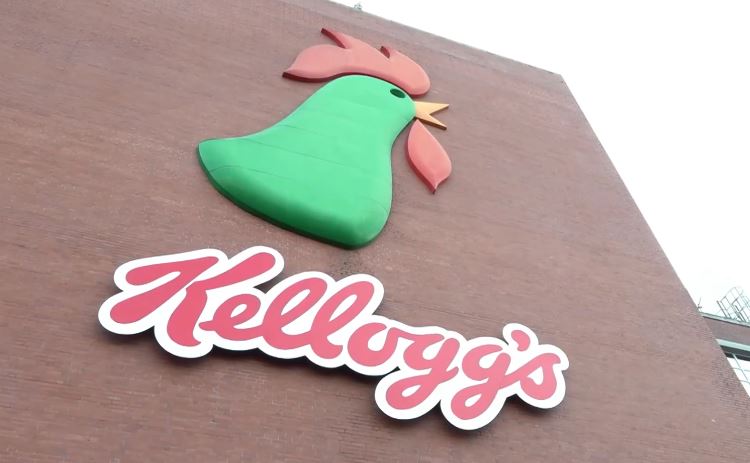
When Kellanova, Kellogg’s parent company, suggested closing the Trafford Park site in February 2024, the site’s future was first questioned. After discussions with labor unions and employee representatives, that decision was formally confirmed in May 2024. The logic wasn’t very dramatic. No product failure, no scandal, no abrupt collapse of the market.
Chris Silcock, managing director for the UK, cited two recurring issues: the factory’s antiquated design and the vast amount of unutilized space inside the structure. When the plant was built in the 1930s, food literally had to go up and down six floors to be processed. In 1938, this arrangement made perfect sense, but in 2026, it hardly made sense. Just half of the structure was in use. Apparently, it would have cost more than it was worth to renovate the remainder to modern standards.
That explanation contains a sort of slow tragedy. The closure is not a tale of carelessness or poor management. It’s more akin to witnessing the sale of a cherished old house because the cost of fixing the roof exceeds the value of the entire building. The managing director of Kellanova stated unequivocally that the decision had “nothing to do with the outstanding people” who worked there.
Although this is what businesses usually say, in this instance, it appears to have been supported by significant action. For employees who agreed to relocate to the Wrexham facility in North Wales, where cereal production is currently shifting, the union Usdaw worked to secure an improved redundancy package and relocation benefits.
Founded in Michigan in 1906, Kellogg’s started shipping to the UK in 1922. The company’s first factory in Britain was located in Trafford Park, which opened on May 24, 1938. That history is insignificant. At this location, Kellogg’s employed several generations of Manchester families, including parents, grandparents, and kids who worked the same jobs decades apart.
Tony the Tiger cutouts and vintage promotional materials were part of an exhibition honoring that legacy held earlier this year at the Trafford Local Studies and Archive Center in Sale. It attracted large crowds. People came because the factory had truly been a part of their family’s history, not because they were nostalgic about corporate history.
The fact that Kellogg’s, or more accurately, Kellanova, which was purchased by Mars, Inc., is opting to remain in the Northwest may be quietly significant. The company’s UK headquarters at MediaCity in Salford and its Wrexham factories, which employ about 1,000 people, will not be impacted by the closure. Thus, this is not a complete departure from the area.
Moving an outdated, ineffective operation into a more modern one, even if that modern one is located 80 miles away in North Wales, is more of a consolidation. That distinction may seem insignificant to the 360 residents who lived close to Trafford Park.
It’s difficult to ignore the fact that the closure of Kellogg’s Manchester plant comes at a time when news of manufacturing closures in Britain has become almost commonplace. Steel from Port Talbot. The vehicles. Corn Flakes now. Each one includes a carefully crafted statement about transition, legacy, and assistance for impacted employees. There are times when the support is genuine and times when it is flimsy.
At least in this case, the union achieved something significant. However, the factory floor remains silent, the jobs are still gone, and whatever happens to that 27-acre site in Trafford Park in the morning won’t smell like toasted grain.
