
I recall sitting there thinking, “Is this really a revelation, or have we just been waiting for a Danish word to give ourselves permission to light a candle and stay home?” when someone at a dinner party in London first described hygge to the entire table, slowly, carefully, and with the tone of someone sharing a discovery.
That was around 2016. Since then, the English-speaking world has imported lagom from Sweden, borrowed ikigai from Japan, and spent a significant amount of money on linen throw blankets, books, and candles. We persuaded ourselves that using an untranslatable word from someone else could fill a very contemporary void. We might have been correct. We might have been looking for shortcuts.
Nearly ten years later, the wellness sector is still searching for the next big thing. The next trend in 2026 appears to be a collective exhale rather than a comfortable Scandinavian sitting room, a subdued protest against the very self-optimization culture that made hygge a retail category.
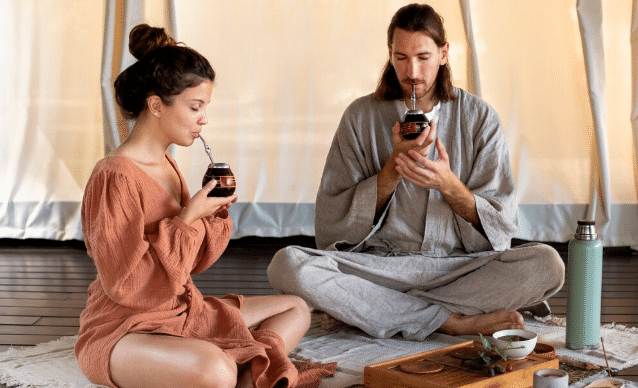
For those who are still getting acquainted, here is a quick introduction. Hygge, which originated in Denmark and Norway, is a particular emotional temperature rather than merely being cozy. Rooms with candles. A select few individuals you truly like. Food that required preparation time. Danes have centered their entire social architecture around it, from the layout of their offices to their evening routines. Around 2016, it went global, which led to a surge in books and a noticeable rise in the importation of candles. It was obvious that people felt they were missing something, regardless of what they believed they were purchasing.
The Swedish entry, Lagom, is essentially the philosophical antithesis of Hygge. Lagom says you probably already have enough blankets, while Hygge suggests adding more. The word means “just right”—balance, moderation, and sufficiency, not precisely minimalism. It may help to explain why Swedish design—clean, practical, and devoid of excess—has subtly taken over so many apartment living rooms across the globe. It’s the Goldilocks principle elevated to cultural value. Regardless of your opinion, IKEA is essentially applied lagom.
The most aspirational of the three is Ikigai, a native of Okinawa and Japan. It roughly translates to “reason for being” and lies at the nexus of your passions, your strengths, what the world needs, and what someone will pay you for. It’s not a modest request. Additionally, it is the most likely to be included in a PowerPoint presentation, which illustrates how these concepts are absorbed by the business world, frequently losing all of their original appeal.
All three, however, share a sort of response to the same query: what if living a good life doesn’t really require more? What if it’s done with genuine attention but requires less?
As 2026 approaches, that question has become much more pressing. Earlier this year, the Global Wellness Summit, which monitors these changes with the level of accuracy typically associated with economic forecasting, observed a dramatic shift in the larger discourse: away from optimization, away from biohacking, away from monitoring your sleep score and calculating your heart rate variability at six in the morning. It appears to be being replaced by a principled return to pleasure. To happiness. To things that are enjoyable just for their own sake.
As this develops, it seems that people are genuinely fed up with being their own wellness initiatives. The eight-step morning routines, the eighteen-hour fasting windows, the cold plunges—somewhere in the process of optimizing every variable, a considerable number of people subtly forgot what they were optimizing for.
Niksen, a Dutch idea that has been circling the wellness debate for a few years without really making an impression, enters this state of exhaustion. It basically refers to deliberate inactivity, such as staring out a window guilt-free, doing nothing on purpose, letting yourself be unproductive, and not putting on a self-improvement intervention. It may finally have its moment in 2026. Not because a groundbreaking study demonstrated its advantages, but rather because a general sense of exhaustion is beginning to set in. Realizing that continuously striving for improvement is a unique form of burnout.
It’s difficult to ignore the change in tone. It felt like permission to be comfortable during the hygge years. It felt like permission to look for purpose during the Ikigai years. Whatever this turns into, it feels like permission to stop. To consume the pastry. To avoid taking a picture of it.
It’s really unclear if Niksen will make it through contact with the wellness market unscathed. Hygge became a line of products. Ikigai became a corporate structure. The commercialization machine is thorough and patient. However, it is more difficult to rebrand the underlying impulse—the fatigue with optimization and the sincere desire for everyday pleasure. Additionally, it’s arguably the most candid thing the wellness discourse has produced in a long time.
FAQs
Q1: What is the difference between hygge and lagom?
Hygge embraces cozy indulgence; lagom prioritizes balance and having just enough.
Q2: Where does ikigai come from, and what does it mean?
Ikigai originates from Okinawa, Japan, meaning “reason for being.”
Q3: What is the newest wellness concept gaining traction in 2026?
Niksen — a Dutch practice of intentional, guilt-free idleness — is emerging now.
Q4: Why are people moving away from self-optimization culture?
Constant self-improvement has become its own form of burnout.
Q5: What do hygge, ikigai, and lagom all have in common?
All three reject excess and center happiness on simplicity and meaning.
