

When you take a sticky toffee pudding out of the oven and discover a sunken, collapsed crater where a beautifully risen sponge should be, it can be quietly devastating. You adhered to the recipe. You took precise measurements. And for some reason, it still collapsed. It’s a frustrating experience that, to be honest, more bakers have encountered than would ever publicly acknowledge.
Usually, there isn’t a single error that causes the sinking. The behavior of the bicarbonate of soda, oven temperature, timing, and even the depth of the dish all play a part. Since the recipe is rarely entirely to blame, it takes some honest analysis to figure out what went wrong.
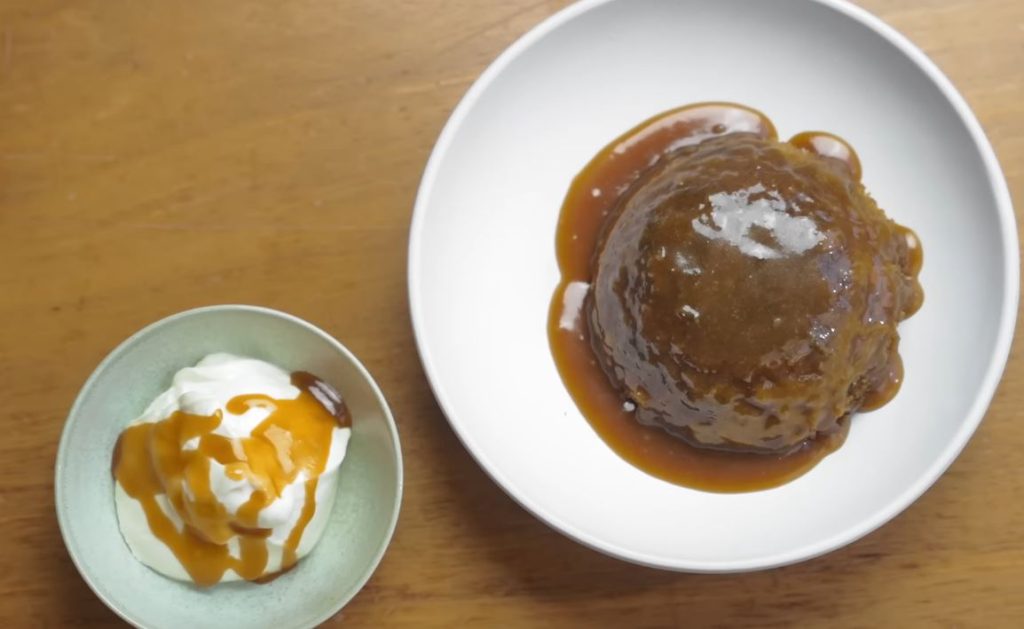
Underbaking is the most frequent offender, and it’s more misleading than it seems. Because of the soaked dates, muscovado sugar, and rich sauce, sticky toffee pudding batter is initially dense and dark, making it appear finished on the outside while the center is still raw and unstable. When you remove it from the heat too soon, the undercooked center just can’t support its own weight as it cools, and it falls. Here, a skewer check is required. It really does matter.
Another area where things quietly go wrong is the oven temperature. When set to the same temperature as a conventional oven, a fan oven operates much hotter—typically by 20 degrees or more. This kind of disparity results in the center remaining underdone while the outside sets and even burns. When a reader’s self-saucing version overflowed, burned on the outside, and collapsed in the middle, Nigella’s own team noticed this exact problem. It was too hot in the oven. It’s that simple, but if you’ve never had an oven thermometer, it’s easy to overlook.
An even more subtle issue is excessive leavening. The acidic dates and the boiling water used to soak them react violently and swiftly with bicarbonate of soda. If there is even a small imbalance, the batter rises too quickly and too high, losing its structural integrity before the flour’s proteins have a chance to set. It’s similar to blowing up a balloon. It becomes nearly inevitable that the collapse will occur. Home bakers have a tendency to believe that more leavening equals more rise, which is technically true for about ninety seconds before becoming disastrously false.
Most people are unaware of the subtle role that overmixing plays. Overworking the batter produces gluten, which is necessary for bread’s structure but causes tension in a delicate pudding that prevents it from rising. In the end, the batter fights with itself. The result is actually altered by gently folding in the flour instead of beating it into submission.
There are unique risks associated with the steamed version of sticky toffee pudding. The foil seal must be correctly pleated and fastened, and the pudding basin must be sufficiently deep—at least four centimeters. The batter near the top of the basin stays wet and unsupported if steam escapes unevenly, which negatively impacts heat distribution. For a Sunday dessert, four hours seems like a lot of work, but it’s not too much. It is possible to determine whether the sponge has set or still requires more time by lifting the foil and gently pressing. Serving something raw in the middle is never preferable to resealing and continuing.
Many bakes are ruined by the stubborn habit of opening the oven door too early. A barely-set sponge just sinks in response to the abrupt pressure drop caused by the rush of cold air inside the oven. It’s difficult to ignore how frequently this caution is mentioned in passing in recipes—almost like a footnote—when it truly merits greater attention. Thirty minutes of meticulous work can be undone by even slightly cracking the door before the minimum bake time.
The issue of dish size is another. An excessively large tin spreads the batter too thin, which simultaneously affects the bake time and internal structure. Overflow and uneven cooking result from a tin that is too small. It balances depth, heat penetration, and batter volume in a way that has been tested, which is why the baked version is advised to be 22 cm square.
It is truly satisfying to make sticky toffee pudding correctly. It’s one of those desserts where patience and focus are more important than skill. The next time, the center holds, the sauce pours cleanly, and the entire dish comes out intact and steaming on a warm plate—that outcome feels well-deserved. And most likely it is.
FAQs
Q1: What is the most common reason sticky toffee pudding sinks in the middle?
Underbaking leaves the centre unstable, causing it to collapse as it cools.
Q2: How does oven temperature affect whether a sticky toffee pudding sinks?
A fan oven running too hot burns the outside while leaving the centre raw.
Q3: Can too much bicarbonate of soda cause a sticky toffee pudding to sink?
Yes — excess leavening makes the batter rise too fast, then collapse before setting.
Q4: Does opening the oven door early cause a pudding to sink?
Cold air rushes in and drops pressure, collapsing a barely-set sponge instantly.
Q5: What dish size should I use to prevent my sticky toffee pudding from sinking?
A 22cm square tin ensures correct batter depth and even heat distribution.
