

Scones on one tray and rock cakes on another, both golden, crumbly at the edges, and reeking of warm butter, can be found sitting side by side in any reasonably good British bakery. Without really understanding what makes them different, most people reach for one. You might be surprised to learn how old that confusion is, and it’s actually more fascinating than it seems.
The short answer is dough: how stiff it is, how it is handled, and how that handling ultimately affects the final baked good. The dough for scones is soft. Before putting it in the oven, you gently pat it, roll it, and then cut or stamp it into shapes. When you split one apart with your thumbs, the result rises uniformly, opens up along the middle, and creates that recognizable layered pull. The dough for rock cake is less cooperative, rougher, and stiffer. It is not rolled by you. Spoonfuls of it are dropped onto a baking tray, where they remain in whatever lumpy shape. The remainder is done by the oven, and the final product resembles a small rock exactly as the name implies: it has an uneven surface, sharp edges, and is not very attractive.
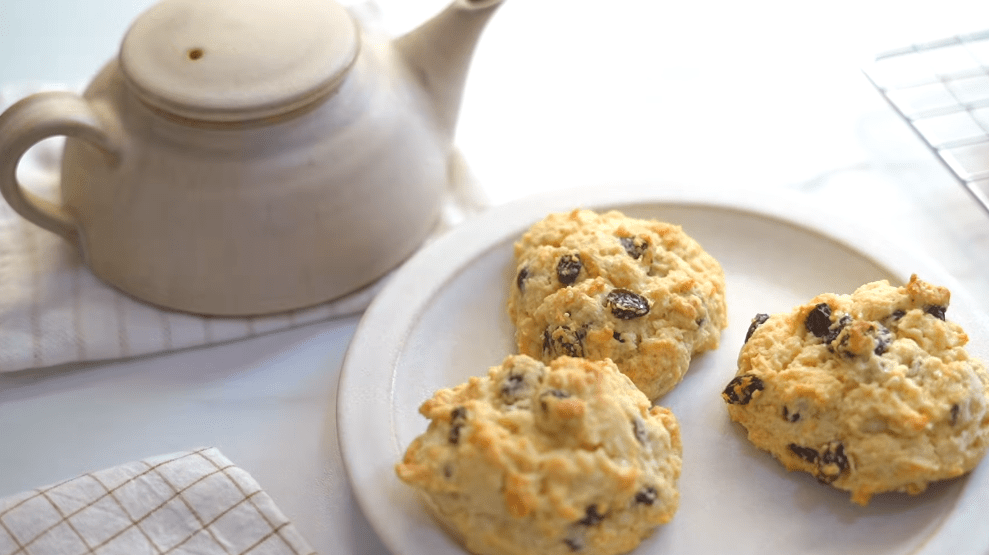
That roughness is not an error. That’s the idea. Rock cakes were never intended to be sophisticated. The British Ministry of Food actively promoted them during World War II because they needed less sugar and eggs than regular cakes, which resulted in significant savings when both were truly scarce due to rationing. Because white flour was more difficult to find during the war, traditional recipes used oatmeal to bulk them out. There’s something subtly amazing about a recipe that originated in scarcity turning into a tea-time mainstay that people continue to bake for enjoyment eight decades later.
Scones have a distinct cultural significance. They come on a three-tiered stand with strawberry jam and clotted cream and are the focal point of an afternoon tea. In England, there is even a long-standing regional dispute over whether the cream or the jam should be served first. Devon believes that the jam should be served first, while Cornwall believes that the cream should be served first. Both sides make this claim with more fervor than the circumstances likely justify. There is no such ritual for rock cakes. The entire ritual consists of eating them warm straight out of the oven.
There is a lot of overlap between the ingredient lists, which contributes to the confusion. Both make use of flour, butter, sugar, egg, and dried fruit, usually currants, raisins, or sultanas. A plain scone lacks the warmth of rock cakes, which frequently contain nutmeg or mixed spices. Before baking, the BBC’s recipe advises sprinkling them with demerara sugar, which gives them a subtle but incredibly satisfying crunch. Whether that qualifies as a topping or merely a finishing touch is still up for debate, but either way, it works.
The ratio and the approach are actually different. Rock cake dough is purposefully stiffer. In practically every traditional recipe, the one thing to avoid is adding too much liquid. When the dough reaches the tray, it should be lumpy and thick. Scone dough is more forgiving, but it requires more skill; if you overwork it, the gluten will tighten, and the scone will turn out dense and disappointing. It’s possible that generations of baking instructors have sent kids rock cake recipes instead of scones because there’s a perception that scones punish inattention more severely than rock cakes.
The Jamaican rock cake is a unique variation that usually has grated coconut with the dried fruit. It serves as a reminder that, like the majority of truly popular dishes, the recipe traveled and changed, absorbing regional ingredients and customs without losing its fundamental qualities.
Even though rock cakes are arguably easier to make and more forgiving to eat on the go—no cream, no jam, and no plate needed—it’s difficult to ignore the fact that they have spent decades in the shadow of scones in terms of prestige. They may be gradually changing, as evidenced by the increasing frequency with which they can be found online in home baking spaces. It’s hard to say if that’s a seasonal trend or a true revival. However, a rock cake is very difficult to argue with on a chilly afternoon when it is warm from the oven and consumed without fuss.
FAQs
1. What is the main difference between a scone and a rock cake?
Rock cake dough is stiffer and dropped onto trays; scones are cut into shapes.
2. Why do rock cakes have a rough, uneven surface?
The dough is spooned onto the tray and left in whatever shape it lands.
3. Why were rock cakes popular during World War Two?
They required fewer eggs and less sugar, making them ideal during wartime rationing.
4. Do scones and rock cakes use the same ingredients?
Mostly yes, but rock cakes typically add dried fruit and mixed spice.
5. Which is easier to bake — a scone or a rock cake?
Rock cakes are more forgiving; overworked scone dough turns dense and disappointing.
