

A flat toad in the hole has a subtly humiliating quality. You have adhered to the recipe. You’ve seen the sausages turn brown. Forty minutes later, you open the oven door to discover something that resembles a pale, deflated rectangle of disappointment rather than a Yorkshire pudding. You poured that batter in with a certain confidence, the kind that comes from thinking you finally understand what you’re doing. Many people experience it. More than they acknowledge.
Toad in the hole batter follows the same logic as Yorkshire pudding batter. It requires intense, instantaneous heat to properly puff up. The amount of heat required before adding batter is something that most home cooks overlook. Not warm. Five minutes without preheating. Truly, appropriately, fiercely hot. The fat in the tin ought to be almost smoking and shimmering. There should be a noticeable sizzle and a little bubbling around the edges when the batter strikes it. The rise is already jeopardized if there isn’t.
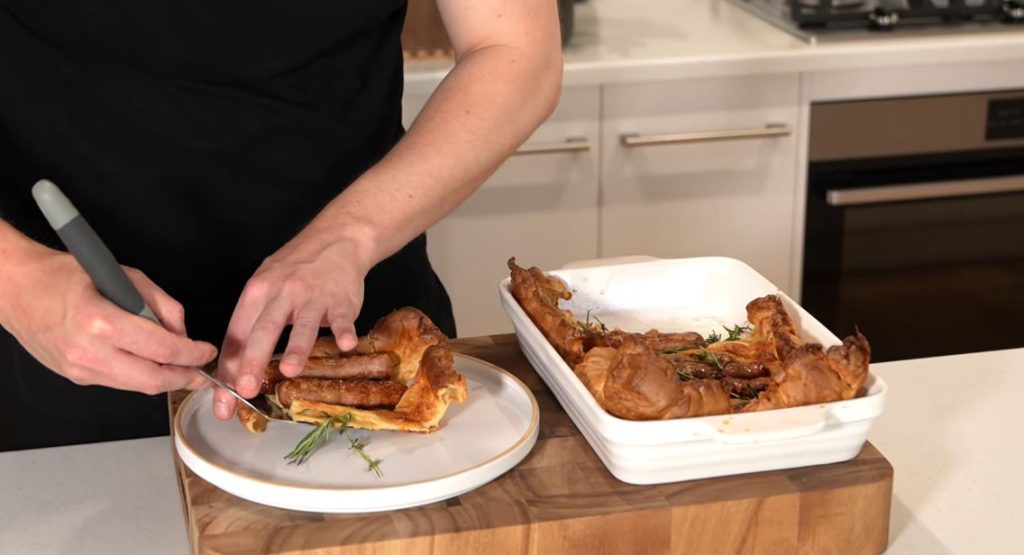
More than most recipes indicate, the tin itself is important. Ceramic dishes have a lovely appearance on a table, but their poor heat conductivity causes them to warm up unevenly and slowly. Glass is comparable. Heat is transferred almost instantly by a metal roasting tin, preferably one with fairly high sides. This gives the batter the sharp thermal shock it needs to climb the walls and puff into something dramatic and golden. Stoneware is not used for puddings in professional kitchens for a reason. It’s not snobbery about aesthetics. It’s physics.
Another thing that subtly derails people is the choice of flour. It seems like self-raising flour should be beneficial—more rise, right? That is not how it operates. Instead of producing the desired airy, crisp structure, the raising agents in self-raising flour produce a different type of lift that results in a dense, cakey texture. Just plain flour. Every single time.
One of those things that, when you’re rushing, seems optional but isn’t is the resting period. The gluten can relax if the batter is left in the refrigerator, covered, for at least half an hour. When the heat pushes the relaxed gluten upward, it becomes more elastic and willing to stretch. By letting the batter rest for a few hours or even overnight, some cooks swear. Although an hour is usually sufficient to see a noticeable improvement, longer rest periods may have a significant impact on both rise and flavor.
The quantity of eggs also merits consideration. A batter made with just two eggs will not rise very well. For a standard dish, three is the minimum. Some recipes call for four. More eggs result in more fat, structure, and the network of proteins that support the batter while it cooks. When adding extra eggs, a small amount of milk is reduced to maintain the proper consistency, which is thin enough to pour but not runny.
It’s simple to make the mistake of overcrowding without realizing it. There is no space for the batter to expand or breathe when eight sausages are packed into a tiny tin. For the batter to climb and billow, there must be open space between the sausages. The batter in the center remains dense and pale long after the edges have begun to set if the tin is overcrowded, which impairs heat distribution. Many otherwise well-executed recipes seem to silently fail at this point because the tin is just too small for the task at hand.
After enough failed attempts, it’s difficult to ignore the fact that the cook who slows down before hurrying to pour is rewarded by the toad in the hole. Let the batter rest. Heat the pan until the fat appears truly hazardous. Make use of a metal dish. Give the sausages room. These procedures are not difficult; they simply call for a slightly different level of care than what most weeknight cooking requires. When it works, as it does, the batter rises around the bronzed sausages in dramatic, uneven peaks that are crisp on the edges and slightly yielding in the center. It’s worth doing correctly.
