

Any typical British baker will recognize a certain type of Sunday morning panic. The baking powder tin rattles after the butter has softened, the eggs have come to room temperature, and the tin has been greased. empty. Or almost. People reach into the back of cabinets, squint at labels, and wonder if cream of tartar and bicarb will work because of that brief moment of dread when they are standing in a kitchen that suddenly smells like anticipation.
The good news is that they will, and most people are unaware of how simple the chemistry is. There isn’t just one magical ingredient in baking powder. It’s a concoction of sodium bicarbonate, powdered acid (typically cream of tartar), and starch for stability. Carbon dioxide bubbles are created when liquid comes into contact with the mixture; these bubbles expand in the oven’s heat, pushing the batter upward. Finding a replacement is therefore much less stressful if you know what you’re replacing and why.
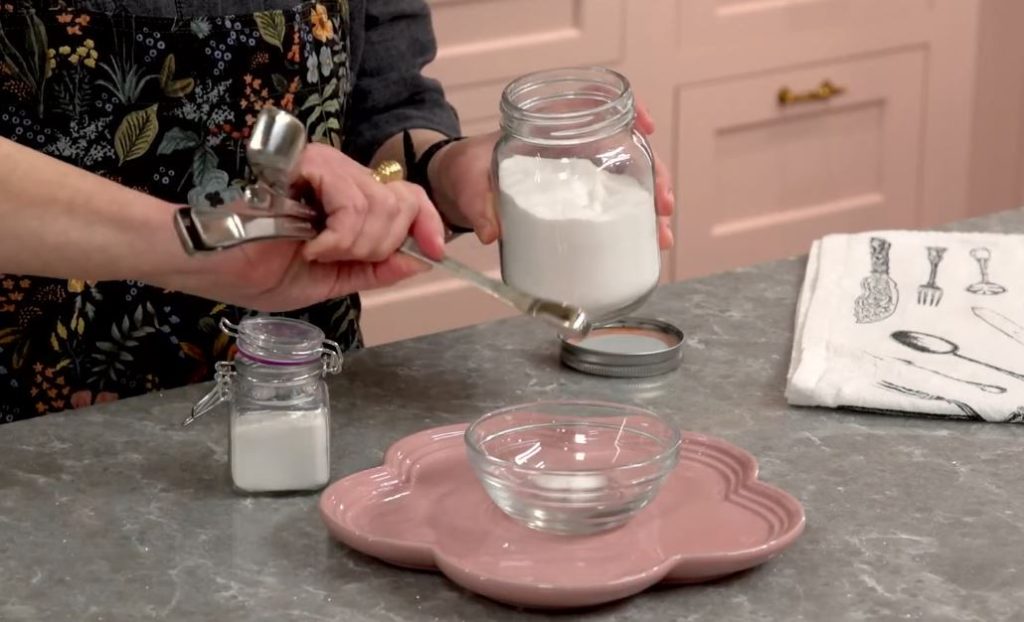
The combination of bicarb and cream of tartar is the closest thing to a perfect swap. For each teaspoon of baking powder specified in a recipe, combine half a teaspoon of cream of tartar and a quarter teaspoon of bicarbonate of soda. Most bakers couldn’t tell the difference in the final product because it closely resembles the original chemistry. For most home cooks, cream of tartar is the most convenient option because it is found in surprisingly many UK cupboards. It is frequently purchased once for a meringue and then forgotten.
Although it requires more adjustment, buttermilk is another dependable option. The same lifting effect is produced when its natural acidity combines with bicarbonate of soda. Five grams of baking powder can be substituted with approximately 122 grams of buttermilk and one gram of bicarb; importantly, any other liquid in the recipe must be reduced by the same amount. Cakes that never quite set in the middle and batters that are too loose are the results of skipping that step. Since fermentation gives plain yogurt a similarly acidic pH, it operates on precisely the same principle. Here, unsweetened yoghurt is crucial because flavored yoghurt adds sugars and stabilizers that can cause unexpected texture problems.
Vinegar and lemon juice both work well for people who don’t have access to dairy products. A quarter teaspoon of bicarbonate of soda and half a teaspoon of white vinegar or fresh lemon juice can be used in place of a full teaspoon of baking powder. Adding vinegar to cake batter seems almost counterintuitive, but the sour edge mostly goes away during baking, especially if you add a tiny pinch of extra sugar. It’s the kind of swap that, until you taste the outcome, seems incorrect.
Whipped egg whites fall into a completely different category since they introduce air mechanically rather than through the same chemical reaction. For recipes that call for a lighter, airier texture, two egg whites whipped to stiff peaks and gently folded into the batter can fairly well mimic the lift of a teaspoon of baking powder. This works well for chiffon-style sponges and angel food cake. A thick fruit cake wouldn’t.
Baking powder and plain bicarbonate of soda are not interchangeable in either direction, so it’s important to understand the differences before you start substituting. Without an acid, bicarb produces a soapy, slightly metallic flavor instead of lift. Because baking powder naturally contains acid, it can be used in recipes that don’t call for other acidic ingredients. When baking powder is needed, using bicarb alone will result in a flat, strangely flavored cake rather than one that has risen.
Before relying on your bicarbonate of soda, it’s a good idea to test it, particularly if it has been stored in the cupboard for some time. It is still active if you drop a small amount into hot water and it fizzes right away. It’s past its best if it just sits there, and mixing it with acid won’t give you the desired rise.
The main idea is that, despite its widespread use in British recipes, baking powder is not indispensable. The majority of its functions can be roughly replicated using ingredients that are already available in a kitchen that is reasonably stocked. Understanding the chemistry well enough to improvise, the kind of knowledge that transforms a near-disaster into a perfectly acceptable Victoria sponge, has a subtle, satisfying quality.
FAQs
1. Can I use bicarbonate of soda instead of baking powder?
Only if you add an acid like cream of tartar or lemon juice.
2. What is the best baking powder substitute in the UK?
A quarter teaspoon bicarb plus half a teaspoon cream of tartar works best.
3. Can yoghurt replace baking powder in a cake?
Yes, but reduce other liquids to avoid a runny batter.
4. Does vinegar affect the taste of baked goods?
The sour flavour mostly disappears during baking, especially with a pinch of sugar.
5. How do I know if my bicarbonate of soda is still active?
Drop it into hot water — active bicarb fizzes immediately.
