

A first-timer lifts the lid off a polystyrene tub and looks at a thick, greenish mush with genuine uncertainty at one point, usually in a seaside fish and chip shop somewhere along the English coast. Is it soup? Is that a dip? Is there a problem? The confusion is understandable, especially for those who have only ever seen pea puree on a restaurant plate next to seared scallops. It is, in fact, mushy peas. They’re both green. Peas are involved in both. Beyond that, they are practically completely different things, made with different materials, prepared in different ways, and bearing completely different cultural significance.
The peas themselves lay the groundwork for the division. Instead of the fresh or frozen garden peas that most people store in their freezer, mushy peas are made from dried marrowfat peas. Larger, starchier, and harvested later in the season, when the moisture has mostly evaporated from the pod, are marrowfat peas. Because of their high starch content, mushy peas have a unique texture that is almost paste-like, and they taste less sweet and more earthy than regular peas. The lengthy process involves soaking the peas in cold water with bicarbonate of soda for the entire night, rinsing them, and simmering them until they collapse into a thick, uneven mash that has been seasoned with salt and pepper. Nothing about the outcome is delicate, and nothing about the process is fast.
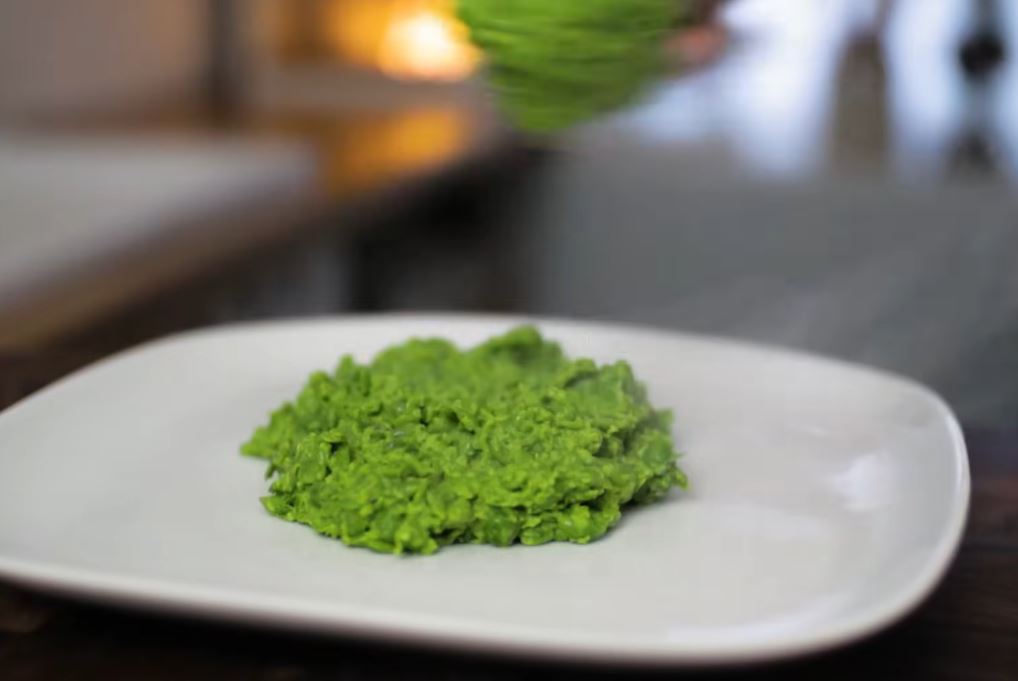
Pureed peas are a whole other story. Bright, sweet, and tender fresh or frozen garden peas are the starting ingredient, and the cooking time is expressed in minutes rather than hours. After blanching the peas and blending them until they are completely smooth, butter, cream, or a squeeze of lemon are frequently added to finish. The end product is a bright green, glossy puree that tastes clean and sweet and has a consistency more akin to a sauce than a mash. It is the type of thing that shows up in eateries with white tablecloths. For their part, mushy peas have traditionally been served with battered cod and wrapped in paper.
It should be noted that the distinction between the two has become less clear in recent years, which is not wholly unexpected. Chefs often take elements of working-class culinary traditions and elevate them, sometimes losing the intriguing aspects of the original. Some restaurant menus now refer to “mushy peas” when, in reality, they are serving a smooth pea puree made with fresh peas; this is technically different and may be misleading. This topic has been extensively discussed in the Reddit food community, with some adamantly pointing out that mushy peas cooked slowly over time yield a fundamentally different product than anything blended in thirty seconds.
The difference is equally noticeable in terms of culture. Because dried peas were inexpensive, nutrient-dense, and simple to store throughout the winter, mushy peas have been a staple of British diets for centuries. Mushy peas were a natural companion by the time fish and chip shops began to appear in the 1800s, as marrowfat cultivation spread throughout the 1700s. By the early 1960s, commercial versions in tin cans were available. Interestingly, the majority of commercially produced mushy peas use artificial colorants to keep their green appearance because without them, the dish turns a murky grey. None of this history is present in pea puree. It is more in line with the traditional French cooking style of vegetable purées, which is meant to enhance rather than soothe.
There’s a feeling that the ambiguity surrounding these two dishes reveals more about the way we discuss food in general. It sounds sophisticated to refer to something as a puree. It sounds like an accident if you call it mushy. However, the rougher texture of mushy peas is a feature, not a drawback. Nothing survives the blender, including the unevenness, the starchy thickness that sticks to a chip and absorbs malt vinegar, and the slight resistance of a pea that hasn’t been completely broken down. If you smooth them out completely, you’ll have something completely different. It’s not the same thing, but it’s definitely something good.
Knowing the difference is more important than you might think, particularly if you are making either dish at home. When making mushy peas, using fresh peas instead of marrowfat peas will not yield the desired outcome because the starch is absent and the texture will be incorrect from the beginning. You will also be let down if you expect mushy peas to have the refined texture of a restaurant puree. It’s still unclear if mushy peas will continue to stand out as something unique and indispensable, or if the blurring of these two dishes in popular culture will eventually eliminate the distinction completely. There is good reason to be optimistic, since they have already survived for centuries.
FAQs
Q1: What type of peas are used to make mushy peas?
Dried marrowfat peas, which are starchier and earthier than regular garden peas.
Q2: Can you substitute fresh peas when making mushy peas at home?
No — fresh peas lack the starch needed for the correct texture.
Q3: Why do commercial mushy peas contain artificial colouring?
Without it, the dish turns an unappetising murky grey.
Q4: What is the key difference in texture between mushy peas and pea puree?
Mushy peas are thick and uneven; pea puree is smooth and glossy.
Q5: How long do mushy peas take to prepare compared to pea puree?
Mushy peas require overnight soaking; pea puree takes only minutes.
