

Every good kebab stand has a moment when someone asks for the red sauce, the salad already wilting at the edges and the paper wrap slightly wet from the meat juices. Not the garlic. The one in red. The spicy one. Unceremoniously drizzled from a plastic squeeze bottle, that sauce has more culinary significance than most people realize. It is slightly acidic, sharp, slightly smoky, and hot enough to be noticeable. And with differing degrees of frustration, home cooks have been attempting to duplicate it for years.
Fortunately, Turkish chilli sauce is not difficult to make. The bad news is that choosing the right chilli is nearly crucial; most recipes hide this information somewhere in the middle of a lengthy ingredient list. Here, Anaheim chillies, which are widely available in supermarkets, are hardly worth the trouble. They produce something more akin to a flavored tomato dip than a true chilli sauce, and they are at the mild end of the Scoville scale. For those who truly want to feel something, cayenne is the bolder option, but jalapeños are a better place to start.
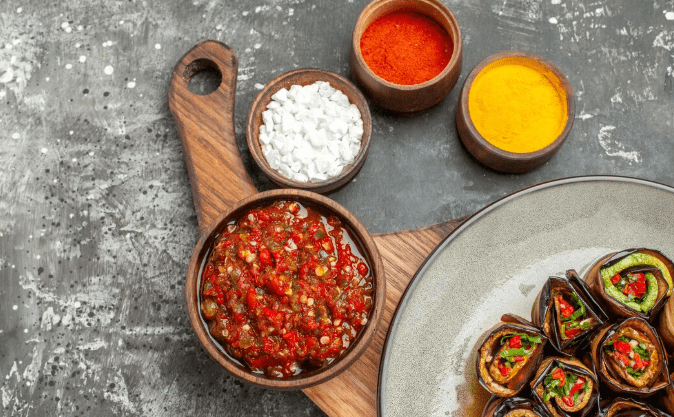
Half a tin of chopped tomatoes, a small red onion, a few red chillies, garlic, tomato purée, and a dash of white wine vinegar make up the foundation of a dependable recipe that is fairly consistent across most variations. Some cooks add sumac, which gives the entire dish a subtle tartness reminiscent of citrus. For a slightly earthier finish, others use mortar-crushed cumin or caraway. Both approaches are effective. It has less to do with a set rule and more to do with what you serve it with.
What’s intriguing—and a little overlooked—is the part vinegar plays in this. Sharpness isn’t the only reason. If you’re making a batch on a Saturday and hoping it still has something to say by Tuesday, it’s important because it stabilizes the sauce and prolongs its shelf life. White wine vinegar keeps the color bright red, while distilled malt vinegar darkens it. That distinction is important for anyone who cares about presentation.
It’s an almost embarrassingly easy method. A hand blender is used to blitz everything into a jar or jug until it is smooth. There is no need for cooking, standing over a pan, or difficult techniques. If you’re going at a typical pace, the entire process takes less than ten minutes. In some way, the outcome tastes as if it came from a place with a functional kitchen and an opinionated grandmother.
It’s difficult to ignore how much of this sauce’s appeal is textural rather than flavorful—that silky, slightly glossy consistency that pools around the base of a kofta or sticks to a flatbread. There’s a reason why, regardless of whose name is above the door, it appears in kebab shops all over Turkey, the UK, and beyond, essentially in the same format. Certain things don’t require repair. Before you realize you’ve been paying someone else for something so simple all along, they simply need to be made at home once.
