
You can find them stacked near the cash register in any British corner store. They are dense, golden squares of baked oats that are a little sticky around the edges and have a smell that is hard to describe but impossible to forget. It tastes almost old-fashioned when you pick one up and eat it.
What’s that? A flapjack. If you go to an American convenience store and pick up a Nature Valley bar, you’ll find something completely different. These bars are lighter, crunchier, and have almond or cranberry bits pressed into the top. Yes, that is a granola bar. Both are good to take in a lunch bag because they are made with oats. After that, the similarities become less clear pretty quickly.
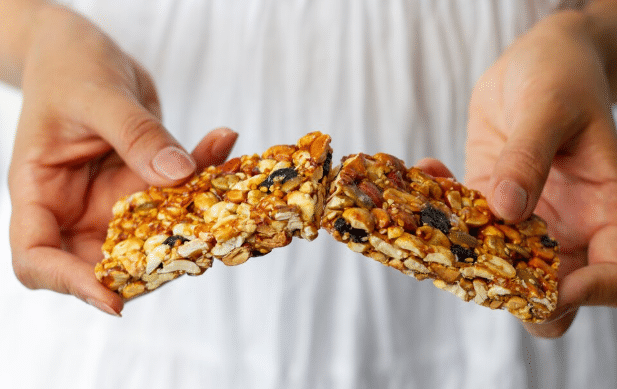
Most people don’t realize how confused these two terms are, in part because the word “flapjack” is really hard for people across the pond to understand. A flapjack in England is a granola bar that tastes more like a dessert. It is made from rolled oats, butter, and brown sugar.
In the US, however, ordering a flapjack at a diner will just get you a stack of pancakes. No matter which side of the Atlantic you’re on, the same word can mean two very different foods. Some people have trouble following international baking recipes at home because of this kind of linguistic quirk. It’s likely that this has ruined more than a few transatlantic baking projects.
What makes a flapjack different from a granola bar is the glue that holds the ingredients together and how they are made overall. In Britain, flapjacks are chewy treats made with oats that are held together by golden syrup and butter. In the United States, granola bars are crunchier and usually have a wider range of nuts, seeds, and dried fruits with a honey-based binder.
It might not seem like a big deal, but the golden syrup really does make a difference. When heated up, it melts into the oats. When it cools, it sets into a dense, almost toffee-like substance. Honey acts differently. It tends to make the finish firmer and drier, which is part of what gives granola bars their signature snap.
Oats, butter, brown sugar, and golden syrup are the only four things that are needed to make a traditional British flapjack. Using golden syrup is thought to be necessary for a real, authentic version. That simplicity is almost purist. There are no marketing tricks like protein powders or dark chocolate coatings, and it doesn’t say that it has fifteen superfoods.
It’s just oats and syrup pressed into a pan and baked until the edges turn golden. This is the kind of snack that you might put in your school bag wrapped in cling film or leave on a plate at a village fete, sliced up. Both the temperature and the way it makes you feel are warm.
Granola bars are made from oats, just like flapjacks, but they usually have less oats and more dried fruits and nuts. For some reason, flapjacks are also a little chewier and softer to eat than granola bars. It’s more important than it seems at first that the texture is different.
The butter-and-syrup base of a flapjack gives it its chewiness; it stays slightly soft even after it cools. Granola bars tend to be more brittle because they are drier and have a wider range of ingredients. Some are almost like crackers, especially the mass-produced kinds that have been squished together in a factory.
It’s also interesting to think about what each one is supposed to be. The British flapjack has always been on the edge of being a snack and a treat. It’s not really healthy because it has butter in it, but it’s also not really dessert either.
People think of granola bars as the “American ancestor” of the popular flapjack, which is often eaten as a snack to get you going or instead of breakfast. That puts the granola bar in a slightly more purposeful category, as something useful that can be taken on a hike or during the morning commute. On the other hand, the flapjack has never really needed a reason other than the fact that it tastes good.
It’s impossible not to notice that both have gotten a lot trickier over the last few years. Modern versions of both are made with a lot of extras, like chia seeds, protein isolates, cacao nibs, and matcha. Someone who learned how to make either one from a handwritten recipe card would probably get lost.
To an American, British oat bars taste like a mix between a granola bar and a Rice Krispies treat. Like granola bars, the exact ingredients used and how much of each are used vary a lot. Because of this, both formats can be changed in almost infinite ways, which may be why they’ve been around for so long.
What stays the same about each is their basic nature. The flapjack is denser, richer, and more decadent. It tastes like something that was baked at home and then cut into rough squares with a table knife. The granola bar is thinner, easier to carry, and better designed. In a strict sense, neither is better. Your mood and, maybe even more telling, which side of the ocean you were on when you tried your first oat-based snack make a big difference. They both deserve to be where they are. They just did different things to earn it.
FAQs
Q1: What is the main difference between a flapjack and a granola bar?
A flapjack uses golden syrup and butter; granola bars use honey with varied ingredients.
Q2: Where does the British flapjack originate?
It’s a traditional British baked oat bar, not related to American pancakes at all.
Q3: Why do flapjacks taste different from granola bars?
Golden syrup creates a dense, toffee-like chewiness that honey simply cannot replicate.
Q4: Can you use honey instead of golden syrup in a flapjack?
Yes, but it produces a firmer, drier result closer to a granola bar.
Q5: Are flapjacks healthier than granola bars?
Neither is strictly healthier — flapjacks are more buttery, granola bars are more varied in content.
