

Opening the oven door on a Sunday afternoon and discovering a tray of Yorkshire puddings that are just as flat as when they entered has a subtly depressing effect. Not a rise. Nothing dramatic. Where tall, golden, crater-topped puddings should have been, there were only twelve pale, slightly oily discs. Both seasoned home cooks and anxious beginners experience it, and the fan oven is frequently the last thing that people consider to be at fault.
At the time, fan ovens had a completely positive impact on British kitchens. The benefits of faster cooking, more uniform heat distribution, and improved browning on roasted vegetables were genuine, and most households gradually made the switch over the previous 20 years. The circulating air that perfectly crisps a tray of potatoes can, in the wrong circumstances, totally ruin a Yorkshire pudding, something that no one has sufficiently warned people about. The forced airflow hampers the delicate process of steam-driven inflation that gives Yorkshires their distinctive puff. A traditional oven produces heat more steadily and quietly. The fan version criticizes it, and most recipe writers don’t realize how important that distinction is.
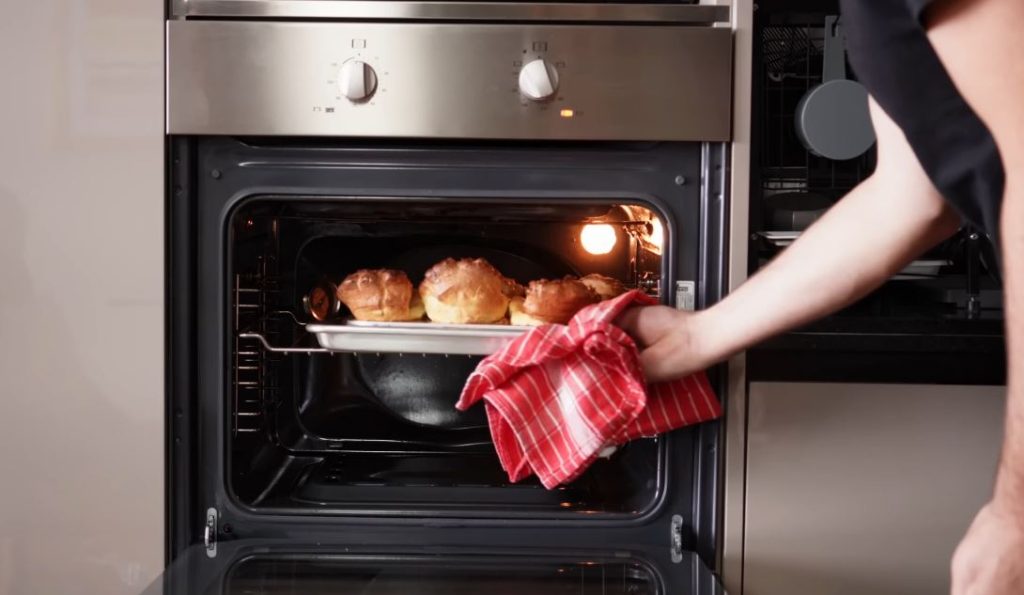
In fact, there are very specific mechanics involved in rising Yorkshire pudding. When cold batter comes into contact with smoking-hot fat, steam is created almost immediately, pushing the batter outward and upward against the tin’s walls. It’s a quick, vigorous process that takes place during the first few minutes of baking and is totally dependent on the conditions being perfect at the precise moment the batter goes into the oven. The circulating air in a fan oven may cool the batter’s surface a little quicker than anticipated, preventing the structure from setting. Many home cooks who switched from conventional to fan ovens may have encountered this issue and attributed it to their recipe rather than their appliances.
Additionally, temperature calibration is more difficult than it seems. Although it may seem simple to lower the temperature by about 20 degrees Celsius when using a fan, fan ovens vary widely by manufacturer and age. After a few years of use, an oven that was calibrated correctly when it was first purchased may read differently. It’s a good idea to start with a fan oven set to 200°C, which is close to the standard recommendation of 220°C. However, if Yorkshire puddings consistently don’t work, it’s worth using an oven thermometer. The oven should be kept at either 200°C fan or 220°C conventional, according to the BBC’s food guidelines. This distinction is still overlooked more frequently than it should be.
What happens to the forced air after the puddings have partially risen is another issue. Regardless of the type of oven, Yorkshires require the oven door to remain firmly closed for at least the first twenty minutes of baking. However, even small temperature changes brought on by the fan’s cycling can cause tiny instabilities in a fan oven, pushing a half-set pudding back down. Although it’s still unclear how much of this is due to the fan itself versus just heat loss, home bakers’ anecdotal evidence consistently shows that fan ovens require more cautious maintenance than conventional ones.
A lot of fan oven failures actually stem from improper fat temperature, which is arguably more crucial than any other single factor. Each cup of the tin must have oil or beef dripping in it that is actually smoking, not warm or shimmering, but just at the point where faint wisps of smoke are rising from the surface. This usually requires eight to ten minutes of preheating in a traditional oven. The visual cues are the same, but a fan oven can accomplish it more quickly. More flat Yorkshires than almost any other error are caused by pouring batter into fat that appears ready but hasn’t quite reached that temperature.
Attention should also be paid to batter consistency. The steam has the best chance of lifting the pudding before the structure closes because of the ratio of equal parts egg, plain flour, and milk, which is thin enough to resemble single cream when properly mixed. The batter relaxes the gluten and yields noticeably better results if it is rested for at least half an hour, or if it is refrigerated overnight and then brought back to room temperature before baking. For a crisper, lighter finish, some cooks swear by replacing half the milk with water. This makes sense because water turns into steam more easily than milk during that crucial first stage.
Given how few ingredients Yorkshire puddings actually contain, it’s difficult to ignore the anxiety that surrounds them in British cooking culture. The recipe itself is incredibly easy. The fan oven has introduced a new variable to a procedure that already required precision, and the execution is the only thing that is difficult. The best strategy seems to be to treat the fan oven as a different tool that needs its own adjustments, rather than as a direct replacement for traditional baking. These adjustments include a slightly lower temperature, vigilance about fat heat, strict discipline about keeping the door closed, and a willingness to accept that the first batch in a new oven might just be a trial run. That isn’t a failure. In reality, that’s how baking operates.
