

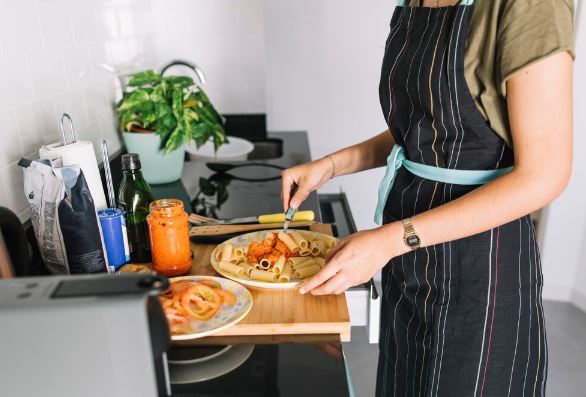
In the weight loss industry, there is a specific kind of irony that is rarely publicly acknowledged. Every year, billions of dollars are spent on app-based calorie trackers, elimination programs, supplement powders, and branded meal plans that all promise some sort of metabolic transformation. In the meantime, the one habit that is most consistently associated with consuming fewer calories and maintaining a healthier body weight is collecting dust between the cutting board and the stovetop in practically every home. Preparing your own food. There is no need for a subscription.
This research is not novel, nor is it unclear. Regardless of whether they were actively attempting to lose weight, people who cooked dinner at home more frequently consumed fewer calories, less sugar, and less fat than those who cooked less frequently, according to a widely cited Johns Hopkins study. According to a different analysis, regular home cooks consumed about 140 fewer calories per day than those who relied on restaurants and prepared meals. On any given Tuesday, that figure might not seem significant, but over several months, it adds up to the kind of gradual, long-lasting change that fad diets seldom produce. It is difficult to ignore the fact that mainstream diet culture hardly acknowledges this finding.
A portion of the explanation is clear. No one can turn your stir-fry on Wednesday night into a source of income. There isn’t a proprietary technique, an influencer angle, or a before-and-after transformation photo that can be traced back to someone who just learned how to sauté vegetables in measured oil. The diet industry thrives on complexity, creating an enemy (such as lectins, carbohydrates, nightshades, seed oils, or eating after seven p.m.) and then marketing the remedy. There is no villain in home cooking. Through the unglamorous mechanics of knowing exactly what went into your food and how much of it ended up on the plate, it simply operates silently.
Restaurant meals virtually eliminate that control factor. Chefs use amounts of butter, oil, salt, and sugar that, if measured out, would actually surprise most home cooks. Because of the preparation method rather than the ingredients, a grilled chicken dish at a casual restaurant may have twice as many calories as a nearly identical plate made at home. The portion issue is another issue. Large plates are served in restaurants because they are worth the cost. Additionally, because they are human, people usually finish what is in front of them. At home, leftovers are packed away before the second helping becomes automatic, and the serving bowl remains on the counter rather than the table.
But there’s more to home cooking than just counting calories and fat grams. Spending twenty or thirty minutes cooking a meal causes a psychological shift. You become less likely to inhale food without realizing it, more conscious of what you are eating, and more connected to the ingredients. One doctor with ties to Harvard recounted seeing a patient with type 2 diabetes who had seen several nutritionists over the years and had learned all the necessary information, but she was unable to put any of it into practice because she just did not know how to cook. She would freeze when she got to the grocery store’s produce section. Dietary pamphlets alone were insufficient to help her learn the fundamentals of cooking.
Cooking education may eventually be incorporated into weight-management and diabetes prevention programs, along with prescription drugs and exercise regimens. Some programs have already demonstrated quantifiable improvements in blood pressure, weight, and diet quality that lasted for up to a year after the study period ended. It’s unclear if the general public will ever view cooking time with the same gravity as GLP-1 prescriptions or gym memberships. To compete with the next miracle protocol, the habit is too easy, too slow, and too unglamorous. However, marketing is not necessary for the kitchen. All you need is someone prepared to stand in front of the stove.
