

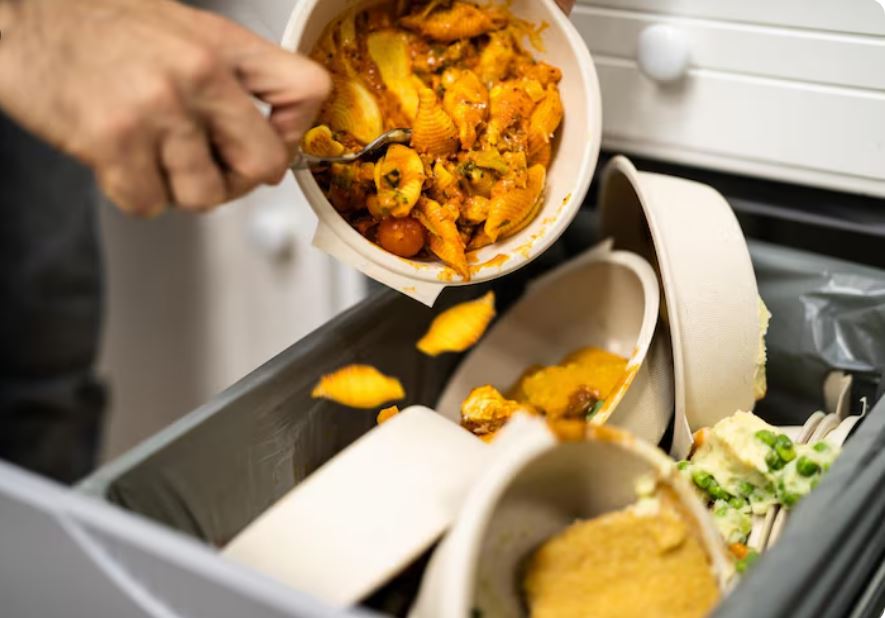
Most British refrigerators currently have a bag of salad at the back. A day or two past the best-before date, slightly damp, and with browning edges. Additionally, there’s a good chance it will be thrown out before the end of the week. You can begin to comprehend how the UK manages to discard about 9.5 million tonnes of food annually by multiplying that amount, which is repeated in millions of kitchens every day. In the process, the typical household loses about £470. It’s not a rounding error. That could be a few hundred unconsumed meals, a month’s worth of grocery shopping, or a brief vacation.
This figure is remarkable because the majority of it isn’t attributable to negligence in any obvious way. Cooking or serving too much food accounts for about 25% of food waste, according to WRAP, a waste reduction charity that has been monitoring UK eating habits for years. Before anyone can get to it, another fifth goes off. And a significant amount is thrown out just because someone didn’t fully grasp the meaning of a date label after glancing at it. These are not spectacular failures, but rather quiet, everyday ones.
It’s worth stopping to consider the confusion surrounding date labels alone. The distinction between “use by” and “best before” is more important than most people realize. When it comes to raw chicken, a use-by date has significance. In terms of safety, a best-before date on a pack of apples, a bag of pasta, or a tin of tomatoes generally doesn’t. Food that has passed its best-before date may be marginally less vibrant and crisp, but it is nearly always safe to consume. Best-before dates have been completely removed from fresh produce in several UK supermarkets, essentially leaving consumers to make their own decisions. It’s a fair request, and kitchens could implement it immediately without waiting for approval.
Another seemingly insignificant problem that gets worse over time is refrigerator temperature. A few degrees above the suggested range of 0°C to 5°C, the typical UK refrigerator operates closer to 7°C than it should. Dairy, fresh herbs, and leafy vegetables all subtly lose days of life due to this gap. What’s already there can be extended with a cheap thermometer and a tiny dial adjustment, which is about as low-effort an intervention gets. When you really think about it, it’s difficult to ignore how much spoilage is caused by easily accessible factors.
The impact of storage practices in general is surprisingly significant. Bread stored in the refrigerator tends to go bad more quickly than bread stored in a bread bin. When potatoes are kept close to onions, the gases they release hasten each other’s deterioration. Instead of becoming slimy in a drawer, fresh herbs can be preserved for up to a week if they are treated like cut flowers and placed in a glass of water.
These changes are not challenging. Part of the issue is that most people were never told these things explicitly. There are gaps in food literacy in the UK, and a 2025 study from Coventry University indicates that these gaps frequently date back to childhood; adults who were more involved in cooking and shopping as children tend to waste less.
The most significant efforts to reduce waste revolve around meal planning. Just a rough idea of what five or six dinners might look like before the weekly shop, and a list that reflects that, rather than intricate planning. One of the more dependable routes to the trash can is impulse buying. If three avocados ripen on the same afternoon, the multipack of avocados reduced to clear is rarely as good as it seems. Meanwhile, freezers continue to be chronically underutilized. Bread, meat that is past its expiration date, leftover soup, and portions of curry that have been prepared in bulk all freeze without any problems and come back to life. It may be the most useful food-saving device that most households already have, but don’t use to its full potential.
None of this necessitates a significant change in one’s lifestyle. The £470 figure sounds high because it is substantial—nearly £10 per week, or about 140 meals annually—but it is actually the result of small, repeated decisions that are, for the most part, reversible. The bin doesn’t need to be the default.
FAQs
How much food does the average UK household waste per year?
Around £470 worth, equivalent to roughly 140 uneaten meals annually.
What foods do UK households waste the most?
Bread, potatoes, milk, bananas, and salad leaves top the list consistently.
What is the difference between use-by and best-before dates?
Use-by is a safety deadline; best-before is simply a quality guide, and food is usually still safe beyond it.
What is the single most effective way to reduce food waste at home?
Meal planning before you shop — it stops overbuying before waste even begins.
Does fridge temperature really affect how quickly food goes off?
Yes — most UK fridges run too warm, shortening the life of dairy and fresh produce by several days.
