

Finding out that a beverage you’ve been packing in your gym bag for years—one that’s practically synonymous with sweaty sidelines and youth soccer competitions—has been subtly recalled across 37 states is almost disorienting. And yet, here we are. PepsiCo confirmed last week that over 122,000 Gatorade cases are being voluntarily removed from shelves because of food dye, not contamination or bacteria. Specifically, yellow dye. It appears that the dye was present in the bottles from the beginning, but it was never stated on the label.
The recall includes four types of 28-ounce Gatorade bottles—Lemon Lime, Lemon Lime Zero, Orange, and Orange Zero—and began on September 25, with the FDA officially announcing it on October 2. These flavors aren’t hidden away in the back of a refrigerator case. These are two of the most well-known sports drink flavors ever created; you can find them in high school locker rooms, gas stations, hospital vending machines, and almost every major grocery chain’s checkout line. At the very least, it’s an odd oversight for a business of PepsiCo’s size that something as basic as a colorant wasn’t mentioned on the packaging.
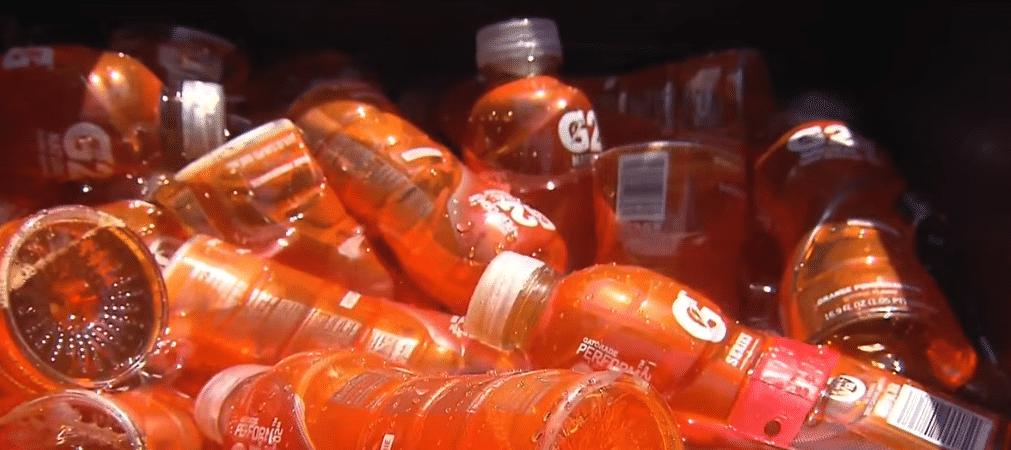
The FDA has designated this as a Class II recall, which indicates that there is little chance of anything major happening and that the health effects are either temporary or medically reversible. Practically speaking, that is comforting, but only to a certain extent. Some people, especially those who are sensitive to aspirin, have been known to experience mild allergic reactions when exposed to Yellow Nos. 5 and 6. Nothing would happen to the majority of people who drank these bottles. However, the lack of that statement on the packaging is more than just a technical error for someone who has spent years carefully reading labels to avoid these dyes. It violates the fundamental trust that underpins food labeling legislation.
The geography of this thing is a little confusing. For what the company describes as a contained issue, the products were distributed in 37 states, which is a remarkably large footprint. Some of these bottles were most likely still on shelves and in refrigerators when the recall was announced because affected lots have expiration dates that extend into April, May, and June of the following year. The particular lot numbers cover over a dozen different codes, indicating that this was a multi-facility, multi-week manufacturing process rather than a single poor production run. PepsiCo has not yet made any public statements, and the FDA’s enforcement report has not been covered by a separate press release.
As this develops, it’s difficult to ignore the fact that food recalls often reveal more than just the particular incident that sets them off. This isn’t a case of listeria. The hospital is empty. However, since synthetic dye legislation began to gain traction in several states, there has been a growing discussion about these kinds of undeclared additives in food policy circles. California has already taken action to limit the use of specific food dyes in educational environments. Earlier this year, West Virginia enacted restrictions. The timing of a well-publicized Gatorade recall involving Yellow Nos. 5 and 6 is almost too obvious.
Customers should compare the lot numbers on the label with the list provided in the FDA’s official recall notice if they think their bottles may be impacted. Codes like 091026 DL, 072226 DT, and 082526 KM are among the lots that are impacted. The recalled products have expiration dates between April and June of 2027, so these are current stock rather than bottles from years ago. The FDA does not declare this to be an urgent public health emergency, but it does advise against consuming the impacted products.
PepsiCo has whole departments devoted to regulatory compliance and generates billions of dollars in beverage revenue every year. Because of this, this recall feels more like a production or labeling process failure than a corner-cutting story. This is the kind of thing that happens at volume, when speed and scale sometimes overtake verification. It’s still unclear if the FDA will demand a closer examination of PepsiCo’s labeling practices in the future or if this will lead to any regulatory action beyond the recall itself.
Checking the refrigerator is currently the most sensible thing anyone can do. If you have a 28-ounce bottle of orange or lemon-lime Gatorade on your shelf at home, turn it over and check the lot code. It could be alright. However, it’s safer to put it down and ask the retailer for a refund if it matches the recall list. The aforementioned dye has been in those bottles the entire time. The fact that you now know is the only thing that has changed.
FAQs
1. Which Gatorade products are affected by the recall?
28-oz Lemon Lime, Lemon Lime Zero, Orange, and Orange Zero bottles are recalled.
2. Why were these Gatorade products recalled?
Labels failed to declare the presence of Yellow No. 5 and Yellow No. 6 dyes.
3. How serious is the health risk from drinking the recalled Gatorade?
The FDA classifies the risk as temporary and unlikely to cause serious harm.
4. Who faces the greatest risk from the undeclared dyes?
People sensitive to aspirin or with existing food dye allergies face the highest risk.
5. What should consumers do if they have a recalled bottle?
Check the lot number against the FDA list and return it for a refund.
