

Certain dishes, plated with tweezers and adorned with unfamiliar ingredients, exist only to impress. Then there’s pot roast. It is never photographed for a gallery wall. At a hip restaurant downtown, nobody orders it. However, pot roast with vegetables is perhaps the most honest dish a kitchen can make on a chilly Sunday afternoon when the aroma of slow-braised beef wafts through the house.
Time is almost the only thing that makes a proper pot roast with vegetables so charming. You can’t rush it. Before the tough connective tissue breaks down and the entire thing becomes something you can pull apart with a fork and a gentle nudge, a beef chuck roast requires hours of low, constant heat. This has been noted for years by chefs like Tyler Florence. His recipe, which has received more than 320 reviews on Food Network, calls for a Dutch oven with a tight lid, fresh rosemary, thyme, and crushed tomatoes. It’s an almost deceptively easy technique. Add your liquid and aromatics, cover, lower the heat, sear on all sides to form a crust, season liberally, and leave for three hours.
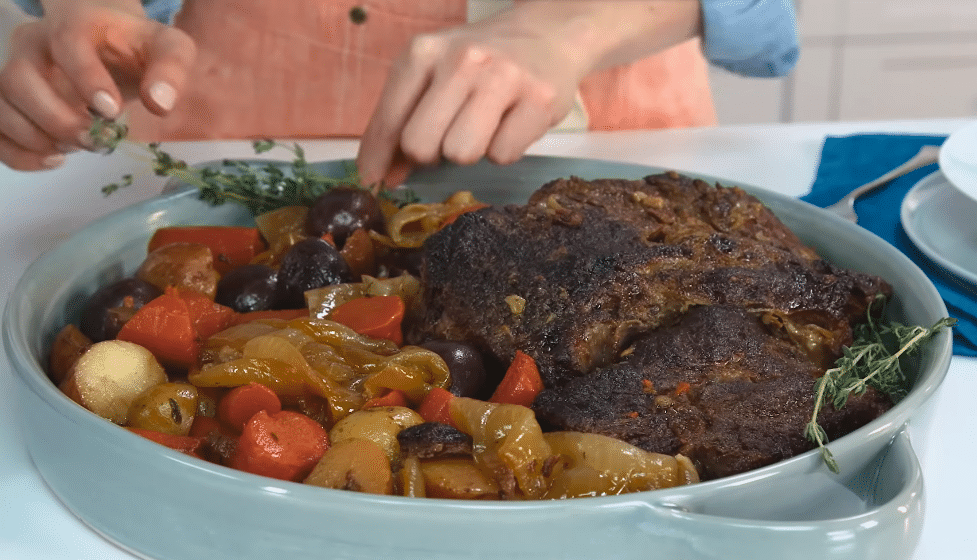
Most people are unaware of how important that sear is. Even though the rich mahogany crust is aesthetically pleasing, it is more than just color. No amount of seasoning in the braising liquid can match the layers of flavor created by the Maillard reaction that occurs when the beef comes into contact with a hot, oiled pan. It’s possible to skip it, but you can tell the difference. The braise has a somewhat bland flavor. A bit thin. The additional ten minutes are worthwhile.
Quietly but persistently, home cooks debate the vegetable issue. If you add them too soon, by the time the beef is cooked, they will have dissolved into a soft, flavorless mush. In order to maintain some texture, the Allrecipes community version, which has 161 reviews and a rating of 4.8, recommends adding root vegetables like red potatoes and mushrooms in the last hour or so of cooking. The dining experience is actually altered by this tiny change. The carrots maintain their shape. Instead of collapsing as soon as you look at them, the potatoes have a bite to them.
There is a version that uses onion soup mix, which sounds like a shortcut and most likely is, but it functions in a way that is difficult to dispute. The mixture is combined with baby gold potatoes, carrots, and a copious amount of beef stock in Jess Larson’s braised pot roast from Plays Well With Butter. The dry mixture adds umami, salt, and a depth of caramelized onion that would otherwise require an hour of careful stirring. A serious cook might disregard this type of ingredient before discreetly putting it in the pantry.
The quality of the braise liquid, the cook’s patience, and the integrity of the vegetables all work together to make a pot roast truly great rather than just passable. Thin, watery flavor is produced by a thin, watery braising liquid. The best versions have a richness that coats the back of a spoon, whether they use red wine vinegar and crushed tomatoes or beef stock and Worcestershire. Eventually, that liquid turns into the gravy, and it should taste as good as its name suggests.
It’s important to note that pot roast reheats wonderfully. Some would contend that it’s better the following day after the liquid has had time to settle and the beef has taken in more of the flavor. Sarah Dugger, an Allrecipes member, suggested shredding hers and eating it like a beef stew, which is actually a good idea. The distinction between braised beef stew and pot roast is less clear than most recipe titles would imply.
Given how consistently pot roast delivers, it is still not entirely clear why it went out of style for a generation or two. Perhaps it seemed too slow for contemporary schedules and too simple for a time when people were fixated on flavors from around the world. However, there is a feeling that it is subtly making a comeback—not as a nostalgic novelty, but just because chilly evenings still occur and one of the more reliable ways to deal with them is with a Dutch oven full of braised beef and root vegetables.
FAQs
Q1: What is the best cut of beef for pot roast?
Beef chuck roast is ideal — it becomes fork-tender after slow braising.
Q2: Should I sear the meat before braising?
Yes, searing builds deep flavour layers that braising liquid alone cannot create.
Q3: When should I add vegetables to the pot roast?
Add them during the final hour to prevent them from turning mushy.
Q4: How long does pot roast with vegetables take to cook?
Depending on the method, anywhere between three and six hours on low heat.
Q5: Does pot roast taste better the next day?
Yes — resting overnight lets the beef absorb significantly more flavour.
