

A cake that refuses to cooperate has a subtly humble quality. Parkin, that dark, oat-heavy ginger cake from the north of England, has a way of appearing flawless when it comes out of the oven, only to later reveal its flaws: it’s too crumbly, too dry, and nothing like the chewy, sticky squares that people associate with Bonfire Night. You’re not alone if you’ve been staring at a tin of disappointingly dry parkin in your kitchen. It’s one of the most frequent complaints about this specific bake, and the recipe isn’t usually the issue. It’s the chronology.
The most common misconception about parkin is that it shouldn’t be consumed raw. As soon as it comes out of the oven, it will nearly always feel dry. That is simply the way the chemistry operates; it is not a flaw. It takes time for the oatmeal and treacle to become comfortable with one another.
Over the course of several days, parkin, sealed in an airtight tin and wrapped in greaseproof paper, gradually softens and acquires the distinctive stickiness that justifies the wait. A minimum of three days is required by some bakers. Others will tell you that a full week is not negotiable, especially those from Yorkshire, where opinions on this kind of thing run strong. Some of the online complaints regarding dry parkin might just be instances of cutting into it too soon.
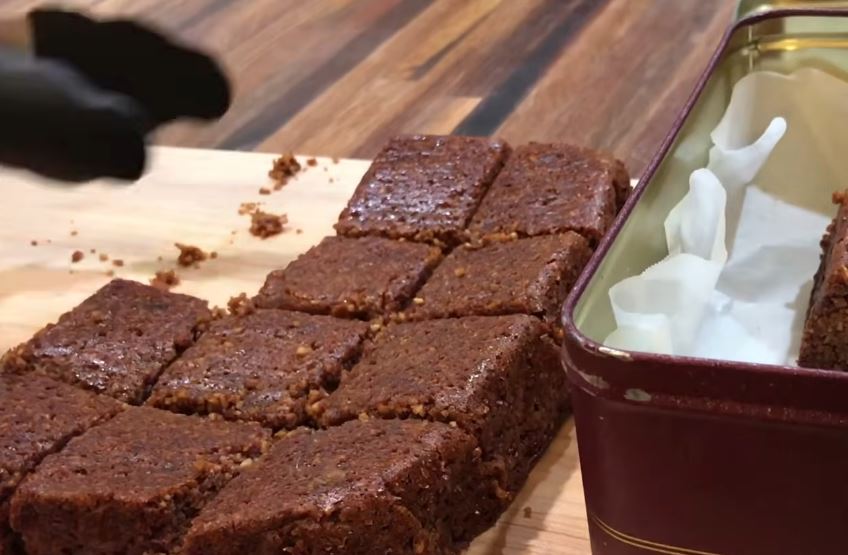
Resting time isn’t always the whole picture, though. Overbaking is a real offender, and it’s not as hard as it seems. In certain aspects, Parkin is a forgiving cake, but when it comes to heat and time, it is harsh. It should be baked slowly at 140 to 150 degrees Celsius, and it should be removed from the oven when the center is still slightly soft. A skewer is usually overdone if you wait until it comes out completely clean. The moisture that was meant to last the resting period simply disappears after ten more minutes at the incorrect temperature. You can’t get over that with just patience.
Another error that often goes unnoticed is boiling the wet ingredients rather than slowly melting them. The majority of recipes require heating the butter, treacle, and syrup until they form a warm, glossy mixture that easily incorporates into the dry ingredients.
Something changes if that mixture reaches a boil. The final texture suffers as a result of the sugars’ different behavior and the liquid’s slight reduction. Although it’s subtle, it has a significant impact. Just until everything melts together, stir slowly over low heat.
Another factor that surprises people is oats. Oatmeal plays a big role in the structure of Parkin, which is not a flour-forward cake because oats are incredibly good at absorbing liquids. The batter will most likely bake dry if it appears stiff or dry when it is placed in the tin. The mixture should be pourable but thick. This can be adjusted without affecting the remainder of the recipe by adding a little extra milk before baking instead of after. The type of oats is also important: rolled oats tend to produce a coarser, lumpier result that can feel dry even when the rest of the cake is fine, whereas fine or medium oats work better here.
Outside of northern England, where the recipe is essentially cultural knowledge passed down through handwritten cookbook pages and kitchen conversations, it’s difficult not to feel a little sorry for anyone baking parkin.
The majority of published recipes have straightforward but inadequate instructions; they frequently tell you what to put in and when to remove it, but they don’t always explain the purpose of the resting period or the unique behavior of treacle in a low oven. The best Parkin recipes are those that seem to have been prescribed by someone who has prepared them numerous times and has faith in your ability to follow their instructions.
If it has been less than five days and your parkin came out dry, wrap it tightly and give it more time. The oven or the oats most likely absorbed too much moisture too soon if it’s still dry after a full week. The next time, remove it a few minutes before you think you should, keep the syrup mixture well below a boil, and make sure there is enough liquid in the batter to make it appear truly wet before adding it. Parkin rewards perseverance. Additionally, it rewards those who approach the recipe as a conversation rather than a checklist.
