

People attempting to eat a little better that week added a pale tangle of threads in a plastic clamshell, which was sold next to the herbs, to their sandwiches. Sitting with that part is worthwhile. The product that consumers most frequently choose while standing in the chilly aisle, squinting at labels, and doing everything correctly is the one that has been linked to disease in fifteen states.
The Centers for Disease Control and Prevention confirmed on Friday that an outbreak linked to alfalfa sprouts grown by Everything Sprouts, a Minneapolis company whose product is sold under the Calco and Everything Sprouts brands in grocery stores and restaurant kitchens, has sickened 55 people. Four have been admitted to the hospital. So far, there have been no fatalities. Before anyone connected the cases, the illness dates, which span from the last day of May to the first week of August, had been moving covertly for about ten weeks.
Nearly seven out of ten infections were absorbed by Minnesota and Wisconsin. The remaining states—Florida, Indiana, Iowa, Kansas, Michigan, New Hampshire, New York, Pennsylvania, the Carolinas, the Dakotas, and Washington—are dispersed widely. Twenty-six of the thirty-four sick individuals that investigators were able to speak with recalled consuming sprouts the week before the onset of symptoms. In terms of epidemiology, that is a strong signal. The person who eats the sandwich never finds it to be that neat.
The bacteriology is what really sets this one apart. A single culprit—a food, a germ, or a narrative—is nearly always responsible for outbreaks. This one contains four strains: one strain of Salmonella and three distinct strains of Shiga toxin-producing E. coli, with two unfortunate individuals simultaneously infected by both. Having two bugs is extremely uncommon, according to Seattle lawyer Bill Marler, who has spent decades suing over foodborne illness. The fact that it was sprouts did not surprise him.
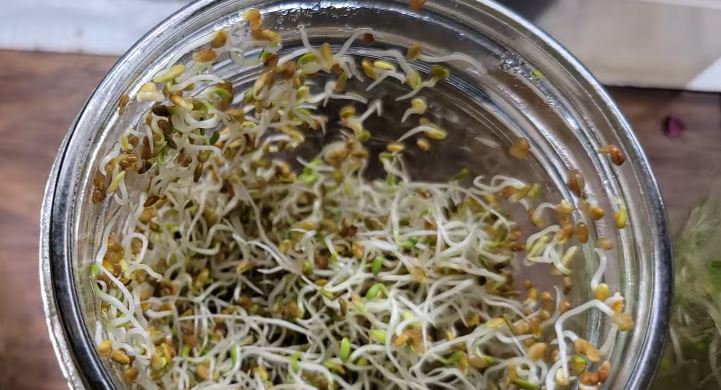
When it sprouts, no one who studies this is ever shocked. The biology of their creation is the source of the issue. The sprouting process, which involves soaking seeds in warm, humid conditions for days—roughly equivalent to a laboratory incubator—does the rest after contamination typically finds its way onto the seed, occasionally from irrigation water or manure in a field far upstream. Anything that exists multiplies. Additionally, no one cooks sprouts, in contrast to ground beef or chicken. There is no heat moment between the growing room and the plate, nor is there a kill step.
The annoying thing is that this is old news. In the late 1990s, a global Salmonella outbreak that sickened over 240 people in seventeen states and beyond was linked to tainted alfalfa seed. In 2022, the CDC looked into another Salmonella cluster associated with sprouts. Years ago, Jimmy John’s removed sprouts from its menu due to persistent issues. For a generation, sprouts have been at the top of the FDA’s list of the riskiest foods, but because they are inexpensive to grow indoors and people enjoy them, clamshells continue to appear.
This is an uncomfortable regulatory paper trail. After an inspection revealed several issues, including a roof that was leaking water onto bean sprouts and onto employees’ smocks, the FDA sent Everything Sprouts a warning letter last year. On August 19, inspectors went back to the Minneapolis facility. The company had yet to issue a recall as of Friday, and reporters who asked for comment had not received a response. There might be a reason. The silence reads poorly from the outside.
Anticipate an increase in the count. Because most people with cramps and two bad days never see a doctor, never get a stool test, and never enter the data, foodborne illness statistics always lag. The percentage of people sick enough to be counted is represented by the 55 confirmed cases. Observing this unfold gives the impression that the sprouts are only half the story; the other half consists of a small producer, a leaky roof, and a system that identified the issue and then bided its time.
Right now, the advice is direct. Look for those two brand names in the refrigerator, discard the package instead of rinsing it, and wash anything it came into contact with. Here, rinsing is ineffective. The odd little humiliation of this outbreak is that the healthiest item in the drawer is the one that must be removed.
